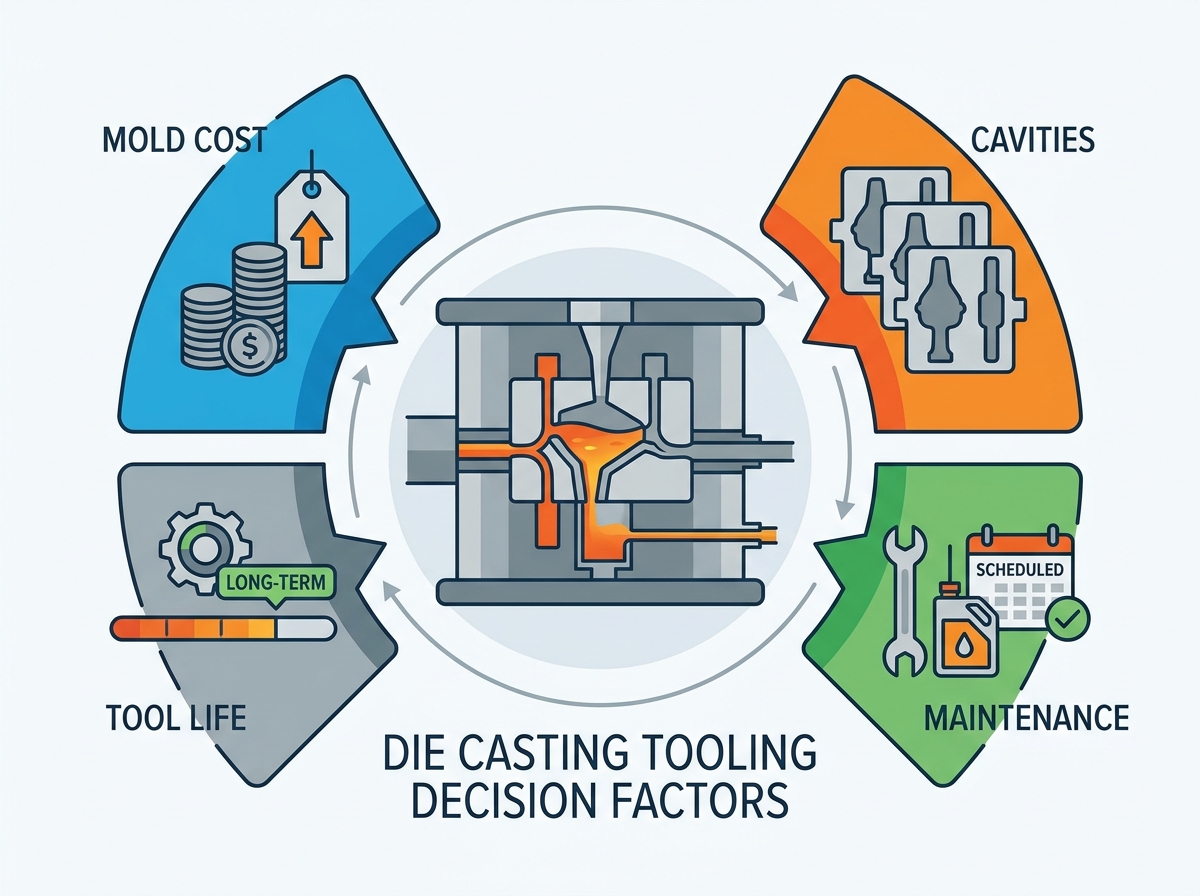
Tooling represents the single most critical capital expenditure in the manufacturing lifecycle. This upfront investment directly dictates both initial financial risk and long-term production profitability. Procurement and engineering teams constantly face the tension between minimizing initial mold costs and maximizing production yield. Under-engineering a tool to save money often leads to premature failure, dimensional instability, and costly production downtime.
This guide provides a technical evaluation framework to align tooling specifications with precise production volume and lifecycle requirements. We will analyze how cavity count, material selection, and maintenance protocols impact the overall success of a project. By understanding these variables, teams can make informed decisions that balance upfront capital expenditure with long-term unit cost efficiency.
Tooling ROI is Volume-Dependent: Upfront mold costs must be amortized over the total expected production run; cheaper tooling often results in higher per-unit costs due to slower cycle times and frequent repairs.
Cavity Optimization Requires Compromise: Selecting between single, multi, or family molds involves strict trade-offs among initial capital, machine tonnage requirements, and part-to-part consistency.
Alloy Dictates Tool Life: Tool longevity is heavily constrained by the casting material—zinc yields high tool life (often 1M+ shots), while aluminum's high melting point accelerates thermal fatigue (typically 100k–150k shots).
Maintenance is a Contractual Imperative: Preventative maintenance and end-of-life refurbishment terms must be explicitly defined in supplier agreements to protect the tooling asset.
Die Casting Fundamentals: The Role of Tooling in Production Economics
How Tooling Dictates Part Quality and Unit Price
Mold precision directly correlates with cycle time efficiency and final part cost. A well-engineered tool ensures consistent dimensional accuracy, reducing the need for secondary machining operations. Gating, runner profiles, overflows, and venting designs control fluid dynamics during injection. These die casting fundamentals minimize gas and shrinkage porosity, optimize surface finish, and reduce scrap rates. Efficient thermal management within the tool dictates cooling rates, which directly impacts cycle times and overall throughput.
Interchangeable die inserts play a critical role in high-wear areas. By utilizing inserts, manufacturers can quickly replace damaged or worn sections without replacing the entire mold base. This strategy maximizes machine uptime and significantly lowers long-term replacement costs. Precision tooling ensures that every shot produces a viable part, driving down the effective unit price over the production run. When a mold is built with high-grade steel and precise machining, the resulting parts require less post-processing, which streamlines the entire manufacturing workflow.
Furthermore, the design of the gating system determines how molten metal enters the cavity. Poor gating leads to turbulence, trapping air and causing porosity. Expert tool designers use flow simulation software to optimize these pathways, ensuring laminar flow and solid, defect-free parts. This upfront engineering effort pays off exponentially by reducing scrap rates and ensuring consistent quality across thousands of shots.
Success Criteria for Tooling Investment
Evaluating a tooling quote requires looking beyond the bottom-line price. Establish baseline metrics including guaranteed shot count, dimensional tolerance capabilities, and expected cycle times. A reliable supplier will provide detailed specifications regarding tool steel grades and heat treatment processes. These metrics form the foundation for calculating true return on investment.
Design for Manufacturability (DFM) is essential for reducing unnecessary tooling complexity before cutting steel. Optimizing draft angles, wall thickness transitions, and parting line placement simplifies mold construction and improves part ejection. Early DFM collaboration identifies potential casting defects and allows for design modifications that enhance tool longevity and production efficiency.
Engineers must also consider the ejection system. Properly placed ejector pins prevent part distortion during removal. If pins are too small or poorly located, they can punch through the part or cause warping. A robust DFM process addresses these mechanical realities, ensuring the tool operates smoothly cycle after cycle without damaging the cast components.
Evaluating Die Casting Mold Costs: Capital Expenditure vs. ROI
Primary Cost Drivers in Die Fabrication
Several variables dictate the price of die fabrication. Overall die size and the complexity of the parting line significantly impact machining time and material costs. The number of slides or cores required for undercuts adds mechanical complexity and increases the overall investment. Furthermore, the grade of tool steel required for the specific casting alloy drives raw material expenses.
Manufacturers can utilize custom standalone mold bases or modular unit die insert systems. Systems like Master Unit Die (MUD) bases offer substantial cost reduction for lower-volume runs by standardizing the outer frame. Proportional cost breakdowns typically reveal that CNC machining and EDM time constitute the largest expense, followed by raw materials and engineering design time.
Tooling Approach
Initial Capital Requirement
Production Volume Suitability
Design Flexibility
Custom Standalone Mold
High
High Volume (100k+ parts)
Maximum flexibility for complex geometries and large parts.
MUD Insert System
Low to Medium
Low to Medium Volume
Limited by standard frame sizes; best for smaller, simpler parts.
Family Mold
Medium
Matched Sets
Requires strict runner balancing; high risk if one part fails.
Hidden Costs and Procurement Risks
Procurement teams often overlook hidden expenses during the initial quoting phase. Initial sampling, including T1 and T2 trials, incurs machine time and material costs. Tool modifications post-sampling are frequently necessary to dial in dimensional tolerances. Specialized surface treatments or coatings required to extend tool life also add to the final bill.
Opting for substandard tooling introduces significant production risks. Inferior molds often result in higher scrap rates and increased flash, which requires labor-intensive secondary trimming. Premature tool failure disrupts supply chains and forces unexpected capital expenditure for replacement molds. Investing in quality tooling upfront mitigates these hidden costs and ensures stable production.
Cost-Benefit Analysis: Domestic vs. Offshore Tooling
Sourcing molds domestically versus internationally presents distinct trade-offs. Offshore tooling often provides lower upfront costs due to reduced labor rates. However, these savings must be weighed against risks related to intellectual property protection, communication delays, and shipping logistics.
Executing engineering changes on offshore tools can be challenging and time-consuming. Domestic sourcing typically offers faster iteration cycles, easier communication, and stronger IP enforcement. Buyers must evaluate the complete lifecycle implications, factoring in potential delays and quality control issues when selecting a tooling supplier.
Determining the Optimal Number of Cavities
Single-Cavity vs. Multi-Cavity vs. Family Molds
Defining the mold type is crucial for aligning production capacity with unit cost goals. Single-cavity molds are best suited for complex, large parts or low-volume production runs. They offer simpler tooling design and easier process control. Multi-cavity molds are essential for high-volume, continuous production, as they significantly lower unit costs by producing multiple parts per cycle.
Family molds are useful for producing matched sets of different parts within a single shot. However, they carry the risk of unbalanced filling. If one part fails quality checks, the entire shot may be scrapped, negating the efficiency gains. Careful runner design is required to ensure simultaneous filling of all cavities in a family mold.
Production Volume vs. Tooling Cost Trade-offs
Calculating the break-even point is necessary to justify the cost of adding cavities. A multi-cavity tool requires a higher initial investment but yields a lower piece price. Procurement teams must analyze projected production volumes to determine when the savings in unit cost offset the increased tooling expenditure.
Determine the total projected production volume over the product lifecycle.
Calculate the unit cost difference between a single-cavity and multi-cavity tool.
Divide the additional tooling cost of the multi-cavity mold by the unit cost savings to find the break-even volume.
Assess machine availability, as multi-cavity tools require larger tonnage machines.
For low-volume projects, the high cost of a multi-cavity mold may never be recovered. Conversely, using a single-cavity mold for high-volume production results in excessive cycle times and inflated unit costs. Accurate volume forecasting is critical for optimizing cavity count.
Impact on Cycle Time, Machine Tonnage, and Shot Volume
Adding cavities increases the projected surface area of the shot. This requires larger machines with higher locking forces (tonnage) to prevent the mold from opening during injection. Larger machines command higher hourly operational rates, which must be factored into the unit cost analysis.
Runner balancing is essential for multi-cavity molds to ensure simultaneous and uniform cavity filling. Improper balancing leads to premature freezing and localized defects. Increased shot volume also demands efficient cooling system design to maintain acceptable cycle times and prevent thermal degradation of the tool.
Die Casting Tool Life Expectations and Material Selection
Standard Tool Life by Casting Alloy
Tool life is heavily dependent on the metal being cast. Zinc alloys, with their low melting points, yield high tool life, often ranging from 500,000 to over 1,000,000 shots. Magnesium alloys typically allow for 200,000 to 500,000 shots before significant wear occurs.
Aluminum alloys possess high melting points and corrosive properties, which accelerate thermal fatigue. Consequently, aluminum tooling generally lasts between 100,000 and 150,000 shots. Understanding these evidence-based shot count ranges is vital for lifecycle planning and budgeting when initiating a die casting program.
Casting Alloy
Melting Point (Approx.)
Expected Tool Life (Shots)
Primary Wear Mechanism
Zinc
380°C - 390°C
500,000 - 1,000,000+
Mechanical wear, minor erosion
Magnesium
595°C - 650°C
200,000 - 500,000
Thermal fatigue, oxidation
Aluminum
660°C
100,000 - 150,000
Severe thermal fatigue, soldering, erosion
Premium Tool Steels and Heat Treatment Standards
High-volume aluminum casting necessitates high-grade materials such as H13, Orvar Supreme, Dievar, or specialized maraging steels. These premium steels offer superior resistance to thermal fatigue and mechanical stress. Compliance with NADCA (North American Die Casting Association) #207 standards for premium H13 and heat treatment parameters is essential to guarantee tool performance.
Proper heat treatment, including hardening and tempering, achieves the necessary toughness and ductility to resist cracking. Inadequate heat treatment compromises the structural integrity of the die, leading to catastrophic failure under the extreme pressures of injection. The steel must be quenched rapidly enough to form martensite but controlled to prevent distortion.
Wear Mechanisms: Thermal Fatigue, Soldering, and Erosion
Die degradation occurs through several physical realities. Thermal fatigue, or heat checking, manifests as micro-cracking caused by rapid heating and cooling cycles. Soldering occurs when molten metal fuses to the die surface, requiring manual removal and damaging the tool finish.
Erosion is the physical wear resulting from high-velocity molten metal injection. High-wear areas, such as gate locations and runner transitions, are particularly susceptible to erosion. Understanding these mechanisms allows engineers to design tools that mitigate wear and extend operational life.
Advanced Surface Treatments and Coatings
Post-processing surface treatments offer a strong return on investment by extending shot life. Nitriding (gas or ion) increases surface hardness and wear resistance. Physical Vapor Deposition (PVD) coatings, such as CrN or AlTiN, mitigate soldering and provide a protective barrier against erosion.
These advanced treatments reduce maintenance frequency and improve part release. While they add to the initial tooling cost, the extension of tool life and reduction in downtime often justify the investment for high-volume production runs.
Preventative Maintenance and Tooling Protection Protocols
Routine Maintenance During Production
Standard operating procedures for routine maintenance are critical for tool longevity. Daily cleaning, application of appropriate die release agents, and inspection of ejector pins prevent mechanical binding and surface damage. Monitoring cooling lines for scale buildup ensures consistent thermal management.
Thermal management design optimization, including conformal cooling channels, baffles, and bubblers, reduces cycle times and controls thermal gradients. Proper maintenance of these cooling systems prevents localized overheating and extends the life of the die.
Major Refurbishment and Welding Repairs
Mid-life tool refurbishment involves stress relieving to close micro-cracks, welding worn areas, and re-machining critical dimensions. Predictive stress-relieving tempers, scheduled at designated shot intervals (e.g., every 25,000 to 50,000 shots for aluminum), significantly delay the onset of severe heat checking.
There are limits to repair. When a tool exhibits extensive cracking or dimensional instability that cannot be corrected through welding and machining, it is considered dead. At this point, a complete replacement or the installation of new inserts is required.
Supplier Agreements: Ownership and Maintenance Liability
Structuring contracts with casting partners requires clear definitions of ownership and liability. Agreements must specify who owns the CAD data and the physical tool. Financial responsibility for routine maintenance versus end-of-life replacement must be explicitly detailed.
Contracts should also outline how tooling transfers are handled if the supplier relationship ends. Clear documentation protects the tooling asset and ensures continuity of supply, preventing disputes over maintenance costs and tool ownership.
Conclusion
Die casting tooling should be evaluated as a long-term production asset rather than a one-time purchase. The correct investment depends on projected lifecycle volume, part complexity, cavity count, casting alloy, machine requirements, cycle time, and expected tool life.
Single-cavity or modular insert tooling can control initial costs for lower-volume programs, while multi-cavity dies may justify their higher investment through greater output and lower unit costs at scale. Material selection is equally important, as aluminum casting exposes tools to greater thermal fatigue than zinc and may require premium steels, coatings, replaceable inserts, and scheduled refurbishment.
Before approving a tooling package, buyers should confirm the guaranteed shot life, expected cycle time, steel grade, cooling design, maintenance plan, ownership rights, and replacement responsibilities. The lowest initial mold price does not necessarily deliver the lowest lifecycle cost or the most reliable production.
FAQ
Q: How much does a die casting mold cost?
A: Mold costs vary significantly based on complexity, size, and material. Simple zinc molds require less investment, while complex, multi-cavity aluminum molds requiring premium steel and advanced cooling demand substantial capital. The cost is driven by CNC machining time, raw materials, and the number of moving components like slides or cores.
Q: What is the typical tool life for aluminum die casting?
A: The industry standard for aluminum tooling is 100,000 to 150,000 shots. This relatively short lifespan is due to aluminum's high melting point and corrosive nature, which accelerates thermal fatigue and soldering. Tool life depends heavily on part geometry, steel quality, and maintenance practices.
Q: How do you increase the life of a die casting die?
A: Extending tool life requires proper thermal management to control heating and cooling cycles. Utilizing premium H13 steel, applying stress-relieving treatments at regular intervals, and adhering to strict preventative maintenance protocols, including daily cleaning and inspection, are essential for maximizing shot count.
Q: What is the difference between a multi-cavity and a family mold?
A: A multi-cavity mold produces multiple identical parts in a single cycle, optimizing high-volume production. A family mold produces different parts in the same cycle. Family molds require complex runner balancing to ensure all different cavities fill simultaneously and uniformly.
Q: Why is heat treatment critical for die casting molds?
A: Heat treatment processes, such as hardening and tempering, provide the tool steel with the necessary toughness and ductility. This prevents the mold from cracking under the extreme pressures and thermal shocks experienced during the injection process, ensuring dimensional stability and longevity.
With so many years' hard work and development, Ningbo Joyo Metal has built a competitive supply chain in the market to serve the distinguished customers all over the world.
About Us
Your partner for customized metal components/parts manufacturing

 English
 العربية
 Français
 Русский
 Español
 Português
 Deutsch
 italiano
 日本語
日本語 한국어
한국어 Nederlands
 Tiếng Việt
 ไทย
ไทย Polski
 Türkçe
 አማርኛ
አማርኛ ພາສາລາວ
 ភាសាខ្មែរ
 Bahasa Melayu
 ဗမာစာ
ဗမာစာ தமிழ்
தமிழ் Filipino
 Bahasa Indonesia
 magyar
 Română
 Čeština
 Монгол
 қазақ
қазақ Српски
 हिन्दी
 فارسی
فارسی Kiswahili
 Slovenčina
 Slovenščina
 Norsk
Norsk Svenska
 українська
 Ελληνικά
 Suomi
Suomi עברית
עברית Dansk
Dansk Afrikaans
 Gaeilge
 Eesti keel
 latviešu
 Беларуская мова
 Български
 Català
 Lietuvių
 Lëtzebuergesch
 Македонски