Tooling represents the single most critical capital expenditure in the manufacturing lifecycle. This upfront investment directly dictates both initial financial risk and long-term production profitability.
READ MORE
Selecting the wrong manufacturing method carries severe operational risks. Engineering and procurement teams often face production delays and compromised mechanical properties when a casting process mismatches the component design intent.
READ MORE
Submitting a vague Request for Quotation (RFQ) to manufacturing partners introduces massive operational risks. Without precise specifications, buyers face hidden costs, inflated tooling estimates, and delayed production timelines.
READ MORE
Bringing a hardware product to market forces engineering and procurement teams to confront a critical manufacturing crossroad. You must transition from prototyping to scalable production without destroying your unit economics.
READ MORE
Choosing the wrong injection mechanism for metal part production leads to accelerated tool wear, unacceptable porosity levels, and inflated production scrap. Product designers and procurement engineers often struggle to balance material requirements with production efficiency.
READ MORE
Specifying the wrong alloy in high-volume manufacturing introduces severe operational risks. Premature tool wear, catastrophic part failure in the field due to creep, excessive secondary CNC machining, and extended cycle times quickly destroy production schedules.
READ MORE
Poor part design wrecks manufacturing operations. It forces extensive tooling modifications, drives up scrap rates, and delays time-to-market. Engineers and procurement teams often fight to balance complex structural requirements with the physical limits of the die casting process.
READ MORE
High scrap rates and part failures in high-volume manufacturing carry a compounding financial impact that goes far beyond the initial cost of the rejected component.
READ MORE
Does an investment casting mold survive the molten metal pouring process? Many engineers and procurement teams ask this exact question when planning a new production run. The short answer is no. The ceramic shell mold used in this process is strictly single-use.
READ MORE
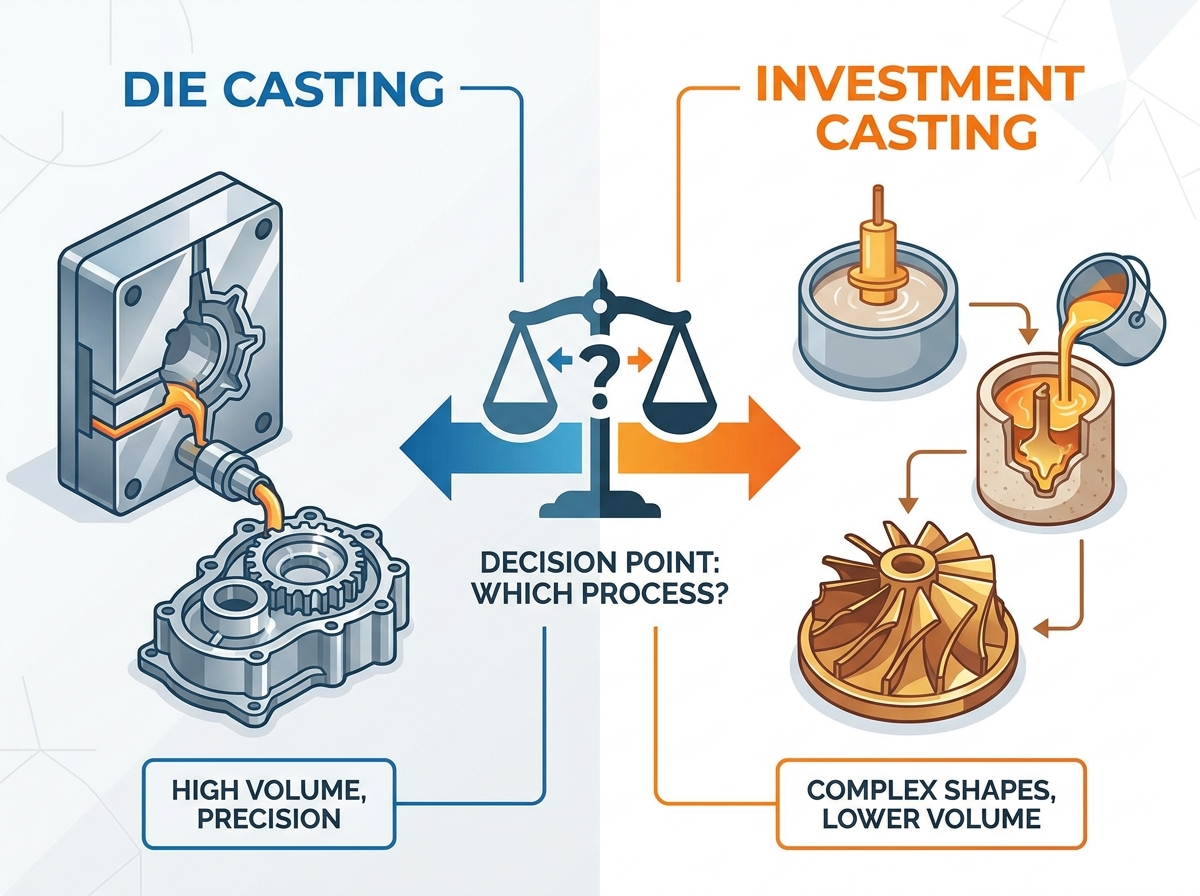
Balancing part complexity, material requirements, and per-unit costs remains a core manufacturing dilemma. Engineers constantly weigh these variables when selecting a production method. Choosing the wrong process often leads to budget overruns, delayed launches, or compromised component performance.
READ MORE