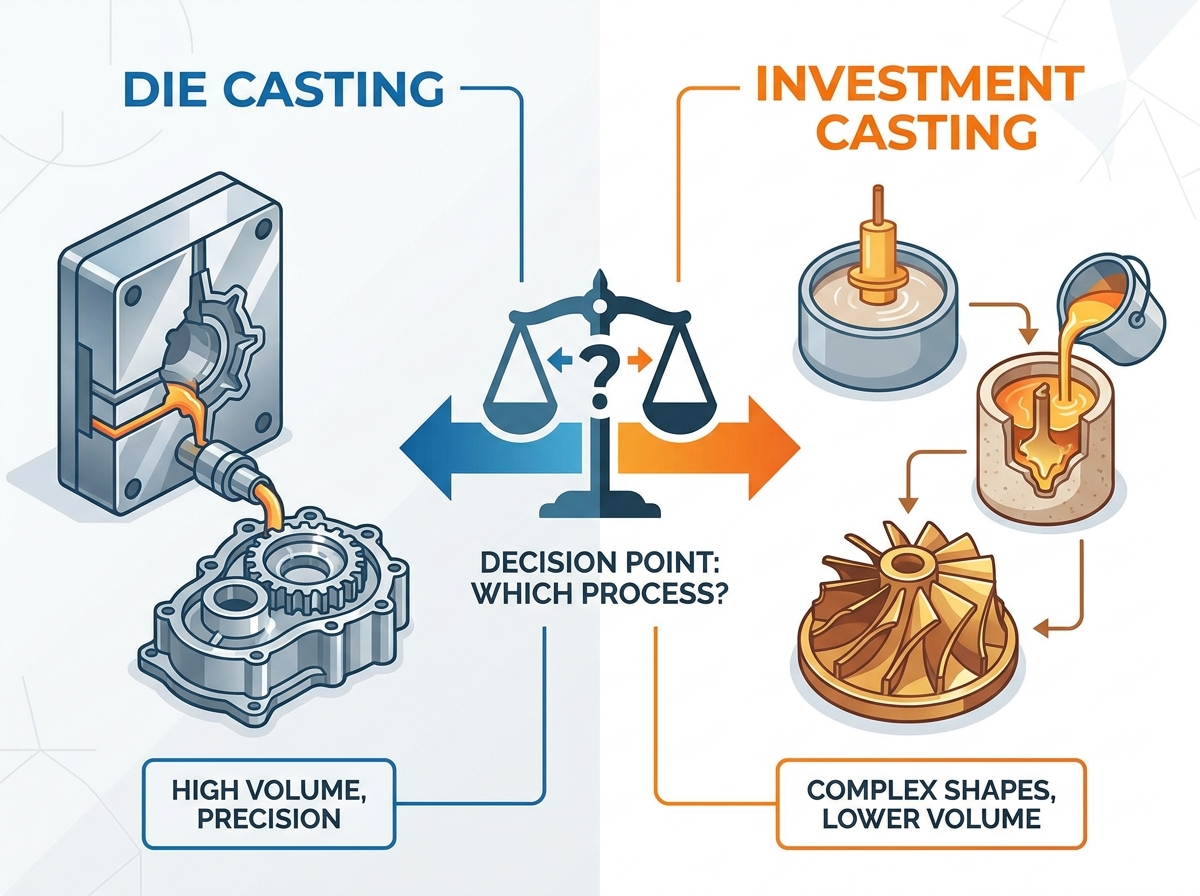
Selecting the wrong manufacturing method carries severe operational risks. Engineering and procurement teams often face production delays and compromised mechanical properties when a casting process mismatches the component design intent. You must balance upfront capital expenditure against long-term unit output. At the same time, you have to adhere to strict material, structural integrity, and geometric constraints. Establishing a clear evaluation framework is mandatory. You need to assess both processes based on production volume, metallurgical requirements, and dimensional tolerances. Making the right choice ensures optimal performance and prevents catastrophic project failures. We will evaluate these methods based on volume thresholds, metallurgical capabilities, and dimensional accuracy to help you lock in the right manufacturing strategy for your specific production run.
Volume dictates the economics: Die casting requires high upfront tooling costs but delivers the lowest per-part cost at high volumes. Investment casting has lower tooling costs but higher per-part costs, suiting low-to-medium volumes.
Material constraints are absolute: Die casting is strictly limited to non-ferrous metals with lower melting points (aluminum, zinc, magnesium). Investment casting accommodates nearly any alloy, including steel, stainless steel, titanium, and superalloys.
Geometric freedom varies: Investment casting allows for extreme internal complexity, thin walls, and zero draft angles, whereas die casting requires specific draft angles and uniform wall thicknesses for part ejection.
Cycle time differences: Die casting is highly automated with rapid cycle times; investment casting is a multi-step, labor-intensive process with longer lead times per batch.
Understanding Die Casting: Process Mechanics and Technical Capabilities
The High-Pressure Injection Process (HPDC)
The high-pressure injection process forces molten metal into hardened tool steel molds under extreme pressures. These pressures typically range from 1,500 to over 25,000 PSI. This rapid injection ensures the metal completely fills the cavity before solidifying. The process splits into two primary operational categories: hot-chamber and cold-chamber. Hot-chamber machines submerge the injection plunger directly in the molten metal. This setup works exclusively for low-melting-point alloys like zinc and magnesium. The submerged mechanism allows for incredibly fast cycle times because the metal is always ready for injection.
Cold-chamber machines require ladling molten metal into a shot sleeve for each cycle. This prevents machine erosion when casting aluminum, which aggressively attacks steel components at high temperatures. Properly understanding die casting requires analyzing clamping force calculations and cycle dynamics. Machines must hold the die shut against massive internal injection pressures. Tonnage requirements can range from 400 tons for small enclosures to over 4,000 tons for large automotive structural components. The hydraulic systems must maintain absolute rigidity to prevent flash and ensure dimensional stability across the parting line.
Ideal Materials and Metallurgical Profiles
This process strictly utilizes non-ferrous alloys due to the thermal limitations of the H13 tool steel dies. Aluminum offers a lightweight profile with excellent thermal and electrical conductivity. It resists corrosion naturally and machines well during secondary operations. Zinc provides high ductility, superior impact strength, and easy plating capabilities. It flows exceptionally well, allowing for incredibly thin walls and intricate details. Magnesium delivers the lowest density and an exceptional strength-to-weight ratio, making it a favorite for handheld devices and aerospace components.
These specific metallurgical profiles serve distinct industrial applications. Automotive manufacturers rely on these alloys for structural parts, transmission housings, and engine blocks. Consumer electronics companies use them for lightweight, durable enclosures that dissipate heat effectively. Aerospace engineers specify these materials for high-volume brackets and internal structural components where weight reduction is a primary objective.
Core Advantages at Scale
Rapid production cycles define the primary advantage of this method. Depending on wall thickness and alloy, a single shot takes anywhere from 10 to 60 seconds. This speed enables massive output rates for high-volume production runs. Automated extractors, robotic sprayers, and conveyor systems further reduce cycle times and minimize human intervention on the shop floor.
High dimensional repeatability remains consistent over hundreds of thousands of cycles. Typical tool life spans 100,000 to 200,000 shots for aluminum components before heat checking requires die replacement. Zinc tooling experiences much less thermal shock and can last up to 1,000,000 shots. Additionally, the excellent "as-cast" surface finish minimizes the need for extensive secondary surface preparation. Parts often come out of the die ready for powder coating, painting, or light vibratory deburring.
Technical Limitations and Mechanical Constraints
The process demands high initial capital expenditure for tooling. Hardened H13 tool steel dies require complex cooling lines, precision machining, and specialized heat treatments. This upfront investment necessitates high production volumes to justify the expense. Low-volume runs simply cannot absorb the initial tooling burden effectively.
High velocity and turbulent die-filling create an inherent risk of gas and shrinkage porosity. The metal sprays into the cavity, trapping air before it can escape through the vents. This porosity generally limits post-cast heat treatment or structural welding. Heating a porous casting causes trapped gas to expand, creating surface blisters. Engineers must follow strict Design for Manufacturability (DFM) rules. Components require specific draft angles, usually between 1° and 3°. Uniform wall thicknesses and strategic parting line placement ensure flawless ejection from the steel dies without galling or distortion.
Understanding Investment Casting (Lost-Wax Method): Process and Capabilities
The Lost-Wax Ceramic Shell Methodology
Investment casting relies on a meticulous, multi-step process that prioritizes precision over speed. It begins with precision wax pattern injection. Operators inject specialized casting wax into an aluminum die to create a highly accurate replica of the final part. Workers then assemble these wax patterns onto a central wax runner or sprue, creating a "tree." This assembly dictates how the molten metal will feed into the individual cavities.
The tree moves into the shell room for coating. Operators dip the assembly into a liquid ceramic slurry and immediately coat it with fine stucco sand. They repeat this dipping and stuccoing process multiple times, allowing each layer to dry in a controlled environment. This builds a robust ceramic shell capable of withstanding molten metal. Once the shell reaches the required thickness, a high-pressure steam autoclave melts out the wax, leaving a hollow ceramic mold. The shell then undergoes preheating and sintering in a furnace to gain structural strength and remove any residual moisture. Foundries pour molten metal into the hot shell using gravity or vacuum assistance. Finally, mechanical vibration, water jets, or chemical baths remove the ceramic shell to reveal the cast metal parts.
Ideal Materials and High-Temperature Alloys
This method offers unmatched metallurgical versatility. It accommodates carbon steels and various stainless steels, including 304, 316, and 17-4 PH. Foundries routinely cast cobalt-chrome, titanium, and nickel-based superalloys like Inconel. Copper-based alloys, bronzes, and specialized tool steels also perform exceptionally well. The ceramic shell can withstand pouring temperatures that would instantly destroy a steel die.
These high-temperature alloys serve critical industrial applications. Aerospace manufacturers use this process for turbine blades that withstand extreme heat and rotational stress. The medical industry relies on it for biocompatible orthopedic implants like knee and hip replacements. Defense contractors produce intricate firearm components, while the chemical processing sector demands corrosion-resistant valve bodies and pump impellers.
Core Advantages for Complex Geometries
The lost-wax method excels at producing complex internal configurations. It handles deep undercuts without requiring draft angles. In fact, a 0° draft is entirely commercially viable because the mold is destroyed during knockout. This geometric freedom allows engineers to consolidate multiple parts into a single casting, eliminating assembly steps and welding operations.
It provides superior dimensional accuracy for complex profiles compared to traditional sand casting. This precision significantly minimizes secondary machining requirements. Furthermore, initial tooling costs remain relatively low. Machinists typically cut wax injection dies from aluminum rather than hardened tool steel. Aluminum machines faster and does not require complex cooling channels or extreme hardening processes. This reduces tooling lead times and upfront capital requirements, making it ideal for prototyping and low-volume production.
Technical Limitations and Constraints
The manual, labor-intensive nature of the process drives up the per-part cost. Consumable materials, such as specialized wax and ceramic binders like colloidal silica, add to the expense. The multi-step processing requires significant human intervention, from wax assembly to shell dipping and final knockout. Each step introduces potential variables that require strict quality control.
Throughput is noticeably slower compared to automated injection methods. Lead times often extend to several weeks per batch due to the drying times required for the ceramic shells. Size and weight limitations also present challenges. Extremely large components require massive handling equipment, specialized dipping robots, and oversized autoclaves. Scaling up part size drives manufacturing costs exponentially upward, limiting the process primarily to components under 100 pounds.
Defining the economic tipping point is crucial for procurement teams. You must amortize the high tooling cost of die casting against the high unit cost of investment casting. The break-even range dictates the optimal manufacturing strategy. You have to look at the total production run over the life of the product.
Investment casting proves most competitive for lower annual volumes. It suits production runs under 2,000 to 5,000 units per year. The low tooling barrier makes it accessible for specialized equipment and low-volume aerospace parts. Conversely, high-pressure injection dominates the economics for annual volumes exceeding 5,000 to 10,000 units. You must evaluate tooling maintenance, tool wear replacement, scrap rates, and post-processing steps when analyzing overall production viability. High-volume runs quickly absorb the initial steel die investment, resulting in a fraction of the piece price compared to the lost-wax method.
Material Properties, Grain Structure, and Heat-Treatability
Evaluating mechanical performance involves analyzing tensile strength, yield strength, elongation, and operating temperature resistance. Ferrous metals automatically disqualify high-pressure injection methods. Their extreme melting temperatures destroy tool steel dies upon contact. If your application requires the strength of steel or the corrosion resistance of 316 stainless, you must use the lost-wax method or sand casting.
Porosity levels differ significantly between the two methods. High-pressure injection often traps gas due to turbulent filling. The gravity-fed, slow-cooling nature of the lost-wax method minimizes gas porosity. Preheated ceramic molds allow for controlled solidification and directional cooling. This enables full heat-treatment processes like annealing, quenching, and tempering to achieve maximum mechanical properties. You can push investment cast parts to their absolute metallurgical limits without worrying about internal gas expansion.
Dimensional Tolerances and Surface Roughness Standards
Industry standards provide a baseline for dimensional expectations. The North American Die Casting Association (NADCA) specifies standard linear tolerances of ±0.002 in/in. The Investment Casting Institute (ICI) outlines typical linear tolerances of ±0.005 in/in. High-pressure injection generally holds tighter tolerances across parting lines and rigid core pulls.
Surface finish metrics also vary. High-pressure injection typically yields a smoother as-cast finish, ranging from Ra 32 to 64 µin (0.8 to 1.6 µm). The steel die imparts a highly uniform surface. The lost-wax method produces surface roughness ranging from Ra 60 to 125 µin (1.6 to 3.2 µm). The final finish depends heavily on the ceramic slurry's particle size and the quality of the initial wax pattern. Both methods produce finishes vastly superior to standard sand casting.
Tooling Lifespan vs. Piece Price Economics
Tooling lifespan impacts long-term manufacturing strategy. High-pressure injection requires substantial initial tooling investments. However, these hardened steel dies last for hundreds of thousands of shots before needing refurbishment. The resulting piece price remains exceptionally low at scale. The automated nature of the process means labor costs per part are minimal.
The lost-wax method features moderate tooling expenses. Aluminum wax injection dies experience virtually zero wear from non-abrasive wax contact. This grants them a nearly unlimited lifespan. However, the labor-intensive production cycle keeps the individual piece price substantially higher. You pay for the manual assembly, the consumable ceramic materials, and the extended processing time required for every single batch.
Evaluation Parameter
High-Pressure Die Casting
Investment Casting (Lost-Wax)
Primary Alloys
Non-ferrous only (Al, Zn, Mg)
Ferrous, Non-ferrous, Superalloys
Economic Production Volume
High to Ultra-high (>5,000–10,000+ units)
Low to Medium (1 to 5,000 units)
Upfront Tooling Cost
Extremely High
Low to Moderate
Per-Part Piece Cost
Low to Very Low
High to Very High
Typical Tolerances (Linear)
±0.002 in/in (NADCA)
±0.005 in/in (ICI)
Surface Finish (Ra)
32–64 µin (0.8–1.6 µm)
60–125 µin (1.6–3.2 µm)
Internal Complexity
Limited (requires draft, slides, lifters)
Highly complex (soluble cores, zero draft)
Heat-Treatability
Poor (unless vacuum/squeeze cast)
Excellent
Design for Manufacturability (DFM) Trade-Offs
Wall Thickness Controls and Shrinkage Porosity
High-pressure injection demands thin, uniform walls. Engineers typically design walls between 1.5mm and 5mm thick. This uniformity prevents internal shrinkage porosity and thermal defects during rapid solidification. Thick sections cool slower, creating internal voids that compromise structural integrity. If a design requires a thick section, engineers must core it out or use ribs to maintain strength while reducing mass.
The lost-wax method accommodates highly variable wall thicknesses. Designs can range from 1mm up to 75mm. The slower, more controlled solidification rate minimizes shrinkage defects. The preheated ceramic shell allows the metal to feed properly into thicker sections as they cool. However, engineers must still design gradual tapers for thick-to-thin transitions to ensure proper metal feeding and prevent hot tears during solidification.
Undercuts, Cores, and Internal Cavities
Forming external undercuts in high-pressure injection requires moving steel cores, slides, and lifters. These mechanical additions introduce severe tooling complexity and increase maintenance requirements. Every moving part in a die is a potential failure point that requires lubrication and precise alignment. Deep internal cavities remain highly restricted due to the inability to extract solid steel cores from complex internal geometries.
The lost-wax method easily resolves complex internal passageways. Foundries utilize soluble wax cores or pre-formed ceramic cores. Operators chemically dissolve or mechanically leach these cores out of the finished casting. This capability allows for intricate internal cooling channels, complex fluid dynamics in valve bodies, and lightweight aerospace structures that would be impossible to machine or cast using rigid steel dies.
Machining Allowances and Secondary Operations
Both processes aim to minimize secondary machining. High-pressure injection achieves tighter linear tolerances, often eliminating the need for subsequent milling on mating surfaces. However, tapping threads and precision boring remain necessary for tight-tolerance functional interfaces. The as-cast holes usually require a quick reaming operation to hit precise dowel pin tolerances.
Investment casting may require slightly larger machining allowances due to its wider tolerance bands. Engineers typically add 1mm to 2mm of extra material on critical mating faces. The ability to cast near-net shapes in hard-to-machine superalloys ultimately saves significant machining time despite these slightly wider tolerances. Cutting Inconel or titanium from a solid billet takes hours; machining 2mm off an investment cast face takes minutes.
To finalize your manufacturing strategy, take the following steps:
Calculate your projected annual production volume to determine the break-even point for tooling investments.
Verify your material requirements against the thermal limitations of tool steel dies.
Audit your part geometry for draft angles, uniform wall thicknesses, and internal complexity.
Consult with metallurgical engineers to confirm heat-treatment and porosity requirements.
FAQ
Q: Can I heat treat parts made from high-pressure injection?
A: Standard high-pressure injection parts generally cannot undergo high-temperature heat treatment. The process traps gas inside the metal. Heating the part causes this trapped gas to expand, creating surface blisters and structural distortion. Vacuum-assisted methods can reduce porosity to allow limited heat treatment.
Q: Why is investment casting so much more expensive per part?
A: The process requires extensive manual labor and multi-step processing. Operators must inject wax, build ceramic shells layer by layer, melt out the wax, and remove the ceramic shell after pouring. Consumable materials like specialized wax and ceramic slurries also increase the unit cost.
Q: What is the minimum wall thickness for investment casting?
A: Foundries can successfully cast walls as thin as 1mm (0.040 inches) depending on the alloy and part geometry. Highly fluid alloys poured into preheated ceramic molds allow the metal to fill thin cross-sections before solidifying.
Q: Do I need draft angles for the lost-wax process?
A: No, draft angles are not strictly required. The ceramic shell is broken away and destroyed after the metal solidifies. You do not need to slide the finished metal part out of a rigid, reusable steel mold.
Q: How long does it take to build tooling for these processes?
A: Hardened steel dies for high-pressure injection typically take 8 to 12 weeks to design, machine, and validate. Aluminum wax injection dies for the lost-wax method usually take 2 to 4 weeks to manufacture, significantly reducing initial lead times.
With so many years' hard work and development, Ningbo Joyo Metal has built a competitive supply chain in the market to serve the distinguished customers all over the world.
About Us
Your partner for customized metal components/parts manufacturing
 English
 العربية
 Français
 Русский
 Español
 Português
 Deutsch
 italiano
 日本語
日本語 한국어
한국어 Nederlands
 Tiếng Việt
 ไทย
ไทย Polski
 Türkçe
 አማርኛ
አማርኛ ພາສາລາວ
 ភាសាខ្មែរ
 Bahasa Melayu
 ဗမာစာ
ဗမာစာ தமிழ்
தமிழ் Filipino
 Bahasa Indonesia
 magyar
 Română
 Čeština
 Монгол
 қазақ
қазақ Српски
 हिन्दी
 فارسی
فارسی Kiswahili
 Slovenčina
 Slovenščina
 Norsk
Norsk Svenska
 українська
 Ελληνικά
 Suomi
Suomi עברית
עברית Dansk
Dansk Afrikaans
 Gaeilge
 Eesti keel
 latviešu
 Беларуская мова
 Български
 Català
 Lietuvių
 Lëtzebuergesch
 Македонски