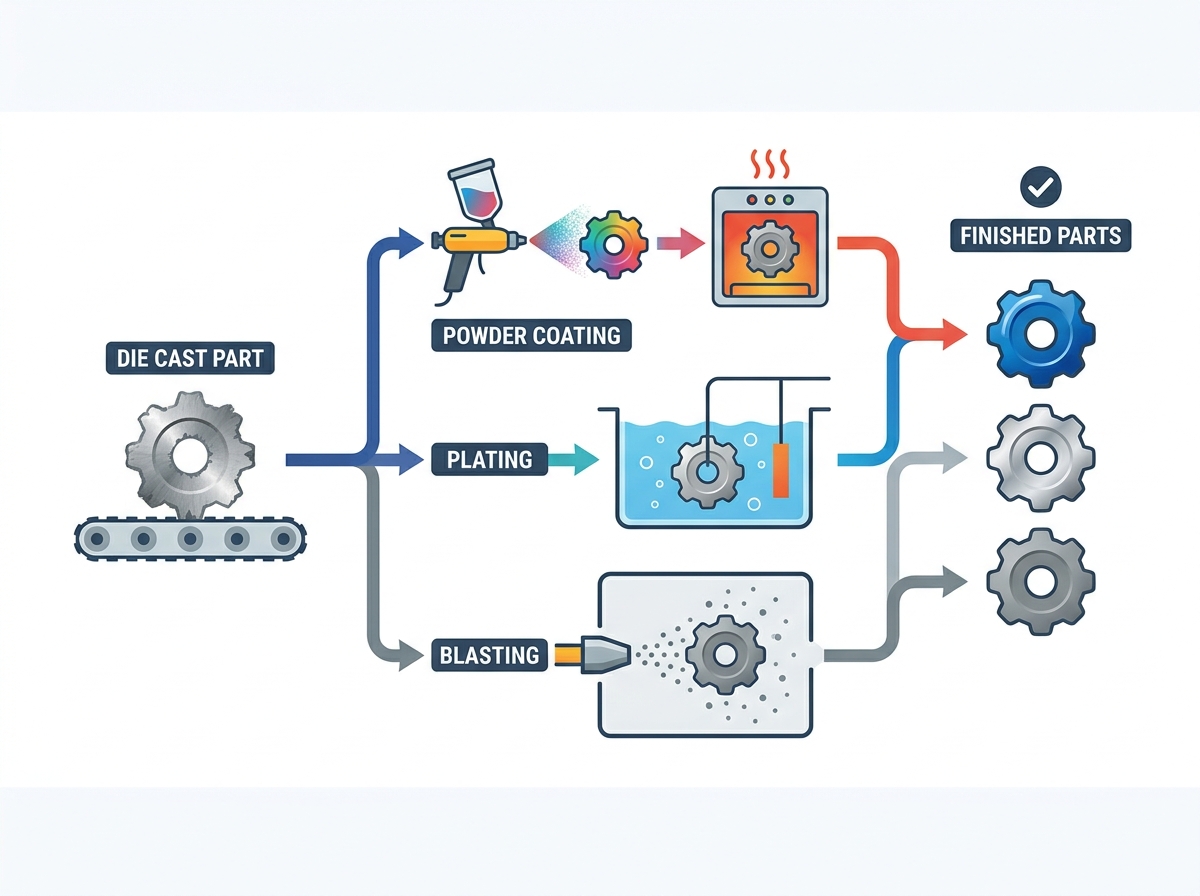
Raw components produced through casting operations rarely meet the stringent aesthetic, functional, or environmental requirements of final end-use applications without secondary processing. Selecting an incompatible surface finish can compromise dimensional tolerances, induce galvanic corrosion, or lead to premature coating failure such as blistering and flaking. These failures inevitably result in costly recalls and production delays in the field.
To mitigate these risks, engineering and procurement teams must rigorously evaluate finishing options. Specifically, evaluating powder coating, plating, and abrasive blasting based on substrate compatibility and the intended operating environment is necessary. Understanding the interaction between the base alloy and the applied finish ensures long-term component reliability. You must match the finishing technique to the specific alloy chemistry to prevent field failures. We will explore how different surface treatments interact with cast substrates to help you make informed engineering decisions.
Abrasive Blasting serves as both a standalone functional finish (matte, deflashing) and a critical preparatory step to improve mechanical adhesion for subsequent coatings.
Powder Coating delivers superior impact resistance, UV stability, and aesthetic versatility, but requires careful management of curing temperatures and alloy-specific outgassing.
Plating (electro- and electroless) is mandatory for components requiring high electrical conductivity, EMI/RFI shielding, or extreme wear resistance, though it requires precise substrate pre-treatment.
The optimal finish depends heavily on the specific alloy chemistry (aluminum, zinc, or magnesium) and the inherent porosity generated by different die casting methods.
The Role of Surface Finishing in Die Casting
Surface finishing bridges the gap between a raw cast part and a field-ready component. The baseline requirements for post-cast components typically include the removal of parting lines, flash, gates, and surface oxides. Meeting these success criteria requires a deep understanding of the base material and how it was formed in the mold.
Substrate Realities by Alloy Type
Different alloys react uniquely to chemical baths, thermal cycles, and mechanical abrasion. You must tailor the surface finishing approach to the specific chemistry of the substrate to achieve a lasting bond.
Aluminum Alloys (e.g., A380, A360): These materials naturally form a protective oxide layer upon exposure to air. However, they require chemical conversion coatings to prevent filiform corrosion from creeping under paint or powder films. If you skip the conversion coating, the paint will eventually peel off in sheets.
Zinc Alloys (e.g., Zamak 3, Zamak 5): Zinc is highly fluid during casting, yielding exceptionally smooth surfaces that accept decorative plating readily. Conversely, zinc is highly susceptible to acid attack, requiring precise control during plating pre-treatments to avoid dissolving the surface layer.
Magnesium Alloys (e.g., AZ91D): Magnesium is extremely lightweight but highly reactive. Components cast from magnesium require specialized passivation, such as anodizing or micro-arc oxidation, prior to applying any topcoat. Without passivation, magnesium will corrode rapidly even under a thick layer of paint.
Impact of Production Techniques
The internal structure and surface density of a component dictate how well it will accept a finish. Various die casting methods yield vastly different porosity profiles, which directly impacts secondary processing.
High-Pressure Die Casting (HPDC): The high injection speed inherent to HPDC increases the likelihood of surface cold shuts and entrapped gas porosity near the component skin. This porosity can trap finishing chemicals or expand during thermal curing, causing surface defects.
Vacuum-Assisted Die Casting: Drawing a vacuum in the mold cavity significantly reduces gas entrapment. This lowers the risk of blistering during the thermal curing processes required for powder coating, resulting in a much higher yield of acceptable parts.
Squeeze Casting and Semi-Solid Molding: These techniques produce high-density parts with minimal porosity, making them ideal candidates for high-temperature finishes and structural applications where internal voids are unacceptable.
Alloy Type
Inherent Surface Characteristics
Primary Finishing Challenge
Recommended Pre-treatment
Aluminum (A380)
Rapid oxidation, moderate porosity
Filiform corrosion under coatings
Chromate or Zirconium conversion
Zinc (Zamak 3)
Very smooth, dense skin
High reactivity to acidic baths
Alkaline cleaning, mild acid dip
Magnesium (AZ91D)
Highly reactive, prone to galvanic corrosion
Rapid degradation in wet environments
Micro-arc oxidation or anodizing
Powder Coating for Die Cast Components
Powder coating provides a robust, thick protective layer suitable for harsh environments. It relies on electrostatic attraction and thermal cross-linking to form a durable barrier against moisture, chemicals, and physical impact.
Mechanism and Application Process
The process begins with the electrostatic application of dry polymer powder, which can be either thermoset or thermoplastic. The charged powder particles adhere to the grounded metal component. To achieve a successful powder coat, you must follow a strict sequence of operations.
Alkaline Wash: Remove cutting fluids, mold release agents, and shop dirt using a heated alkaline solution.
Rinse: Flush the parts with clean water to remove residual alkaline chemicals.
Chemical Conversion: Apply a zirconium or zinc phosphate conversion coating to create a micro-crystalline structure that ensures mechanical adhesion of the polymer.
Dry-Off Oven: Evaporate all surface moisture before powder application to prevent steam pockets under the coating.
Powder Application: Spray the charged powder onto the grounded parts using electrostatic guns.
Thermal Curing: Bake the parts in an oven operating between 350°F and 400°F to polymerize and cross-link the coating into a continuous film.
Performance Outcomes
Powder coating yields exceptional durability, scratch resistance, impact resistance, and chemical resistance. The application process naturally builds a thick, uniform coverage ranging from 2.0 to 4.0 mils. This thickness is highly effective at masking minor casting defects, parting lines, and flow marks that would otherwise require manual sanding.
Furthermore, powder coating offers a broad spectrum of aesthetic options. Engineers can specify precise colors, textures, gloss levels, and even metallic effects to meet consumer-facing design requirements. Textured powders are particularly useful for hiding surface imperfections on large, flat cast surfaces.
Technical Trade-offs & Limitations
Despite its durability, powder coating introduces specific engineering challenges. The macro-additive thickness can interfere with tight-tolerance mating surfaces. You must implement precision masking for threaded holes, datum planes, and grounding points prior to coating. Masking adds significant labor time to the production cycle.
Thermal risks present another significant limitation. High curing temperatures cause entrapped gases in porous castings to expand rapidly. This expansion forces gas through the curing polymer, leading to pinholes and blistering on the surface. To mitigate this, manufacturers use outgassing-forgiving (OGF) powder formulations and implement thermal pre-heating cycles to release gases before powder application.
Best Fit Applications
Powder coating excels in applications requiring robust environmental protection and aesthetic appeal. Common uses include automotive exterior trim, structural brackets, industrial equipment housings, and consumer appliance components. It is the standard choice for outdoor equipment exposed to UV radiation and physical abuse.
Plating Die Cast Parts (Electroplating and Electroless)
Plating deposits a thin metallic layer onto the substrate, fundamentally altering the surface properties to enhance conductivity, wear resistance, or cosmetic appeal. Unlike paint, plating integrates with the base metal at a molecular level.
Mechanism and Application Process
Plating falls into two primary categories: electrolytic and electroless. Each serves a distinct engineering purpose.
Electrolytic Plating: This method uses electrical current to deposit metallic ions, such as copper, nickel, chrome, or zinc, onto the conductive substrate. When plating aluminum alloys, an initial "zincate" immersion step is mandatory to strip the natural oxide layer and prevent instant re-oxidation before the plating metal bonds. Without the zincate layer, the plating will simply flake off.
Electroless Plating: This relies on autocatalytic chemical reduction rather than electrical current. Electroless nickel, for example, provides a highly uniform thickness even in complex internal geometries and deep recesses, avoiding the current density variances that plague electrolytic processes.
Performance Outcomes
Plating creates highly conductive surfaces necessary for ground paths and electrical contacts. It also provides exceptional wear resistance, hardness, and a low coefficient of friction. Co-depositing electroless nickel with PTFE yields a permanently lubricated surface ideal for sliding mechanisms.
For telecommunications and medical devices, plating offers superior EMI/RFI shielding capabilities. Aesthetically, plating delivers high-end decorative appeal, such as bright chrome or satin nickel finishes found in automotive and plumbing sectors. The reflective qualities of chrome plating remain unmatched by any paint or powder system.
Technical Trade-offs & Limitations
Plating introduces the risk of galvanic corrosion. If incompatible metals, like copper or nickel on an aluminum substrate, are paired in wet or marine environments, any breach in the plating layer will accelerate corrosion of the base metal. You must design the plating stack carefully to minimize galvanic potential.
Subsurface porosity bleed-out is a major quality control issue. Acidic or alkaline plating chemicals can become trapped in surface pores during immersion. Over time, these chemicals leach out, leading to post-plating corrosion known as "spotting out" and subsequent adhesion failure. Furthermore, high-strength alloys may suffer from hydrogen embrittlement during acid pickling and plating, requiring immediate post-bake relief processes to restore structural integrity.
Best Fit Applications
Plating is specified for components demanding precise surface functionality. Ideal applications include RF shields, fiber optic connectors, aerospace fasteners, automotive interior trim, and high-wear plumbing fixtures. It is the only viable option when you need a hard, conductive surface on a lightweight aluminum or magnesium casting.
Abrasive Blasting (Shot, Sand, and Bead)
Abrasive blasting is a mechanical surface treatment used to clean, deburr, and alter the surface texture of cast components through the high-velocity impact of abrasive media. It is often the first step in a comprehensive finishing system.
Mechanism and Application Process
The process involves the pneumatic or centrifugal propulsion of abrasive media against the component surface. The choice of media dictates the final surface profile and the amount of material removed.
Glass Beads: Used for achieving a satin finish and imparting compressive stress relief without removing significant base material. Glass beads leave a clean, bright surface.
Steel Shot and Grit: Deployed for aggressive deflashing, heavy scale removal, and surface hardening (peening). Steel media is highly durable and can be recycled many times.
Aluminum Oxide: Utilized for heavy profiling and creating a deep anchor pattern for subsequent coatings. It cuts quickly but breaks down faster than steel.
Organic Media: Walnut shells or plastic beads provide delicate deflashing without altering the dimensional integrity of soft alloys. This is ideal for cleaning precision machined surfaces without damaging threads.
Performance Outcomes
Blasting provides efficient mechanical removal of flash, burrs, scale, and surface oxides generated during the casting process. It creates a uniform, non-directional matte or satin cosmetic finish that hides minor casting flow marks.
Crucially, abrasive blasting increases the surface area and creates a mechanical "anchor profile." This roughened surface maximizes the mechanical adhesion of subsequent paint, powder coats, or thermal spray applications. A properly blasted surface will significantly increase the pull-off strength of any applied coating.
Technical Trade-offs & Limitations
Media embedment is a primary risk when blasting softer alloys like zinc or magnesium. Abrasive particles, particularly sharp aluminum oxide, can embed into the substrate. This creates galvanic cells or causes severe defects in subsequent plating lines. You must select the media hardness carefully based on the substrate.
Aggressive blasting can also cause dimensional alteration and warpage. Thin-walled sections may distort if media size, angle of impingement, and nozzle pressure are not strictly controlled. Additionally, manual blasting lacks the repeatability required for high-volume production, necessitating investment in automated tumble-blast or robotic blasting systems to ensure consistent surface profiles across thousands of parts.
Best Fit Applications
Abrasive blasting is ideal for internal engine components, structural castings requiring pre-treatment before coating, and architectural hardware requiring a uniform, non-reflective matte aesthetic. It is universally applied as a preparatory step for heavy-duty industrial coatings.
Comparative Evaluation Framework: Selecting the Right Finish
Selecting the appropriate finish requires balancing dimensional constraints, environmental exposure, and production volumes. The table below outlines the core differences between major finishing categories to help you specify the correct process.
Selection Criteria
Abrasive Blasting
Powder Coating
Electroplating
Electroless Plating
Dimensional Change
Subtractive to Neutral
Macro-additive (50–100 µm)
Micro-additive (10–30 µm, uneven)
Micro-additive (5–25 µm, ultra-uniform)
Corrosion Resistance
Low (requires post-seal)
Excellent (barrier protection)
Moderate to High
Outstanding (especially high-phosphorus Ni)
Electrical Conductivity
Unchanged
Insulative (non-conductive)
Highly Conductive
Highly Conductive
Thermal Limits
Dependent on substrate
Max operating ~300°F–400°F
High (metal-on-metal limits)
High (metal-on-metal limits)
Aesthetic Versatility
Limited (matte/satin)
Infinite (colors/textures)
High (metallic/reflective)
Moderate (semi-bright to dull metallic)
Tooling/Setup Cost
Low
Moderate
High (requires racks/anodes)
Moderate to High (chemistry-heavy)
Volume Scalability
Moderate (batch-reliant)
High (automated conveyor)
High (barrel/rack lines)
High (bulk chemistry lines)
Implementation Risks and Quality Control
Applying a surface finish is a chemically and thermally sensitive process. Without strict quality control, even the most appropriate finish will fail in the field. You must establish rigorous inspection protocols at every stage of the finishing line.
Pre-Treatment Quality Management
The success of any coating or plating relies entirely on the pre-treatment phase. Chemical baths must be monitored continuously for pH levels, chemical concentration, and temperature. Failure to maintain these parameters results in incomplete oxide removal or poor conversion coating formation, leading directly to poor adhesion and early field failures. Operators should perform titration checks on all active baths at least twice per shift.
Mitigating Substrate Porosity
Porosity is the enemy of surface finishing in die casting. When surface pores trap air or fluids, defects occur during subsequent processing. You must address porosity before the parts reach the finishing line.
Vacuum Impregnation: This process utilizes liquid polymer resins under vacuum to fill subsurface voids prior to plating or powder coating. Curing the resin permanently seals the porosity, preventing fluid entrapment and subsequent outgassing or chemical bleed-out.
Process Selection: Mandating high-vacuum casting methods during the initial design phase minimizes porosity formation for components with strict cosmetic and plating requirements.
Testing and Validation Standards
Verifying finish integrity requires standardized testing protocols. Relying solely on visual inspection is insufficient for functional components. You must implement destructive and non-destructive testing to validate the process.
Adhesion Testing: Utilize the ASTM D3359 cross-hatch tape test to verify the mechanical bonding of paints and powder coats to the substrate.
Corrosion Testing: Implement ASTM B117 salt spray testing to evaluate long-term environmental durability and barrier protection.
Thickness Verification: Use ASTM B487 for microscopical cross-sectioning or non-destructive X-ray Fluorescence (XRF) testing to verify exact plating thickness and uniformity.
Supplier Quality Auditing
Establish key performance indicators for both casting and finishing vendors. Audits should review chemical bath tracking logs, automated masking verification procedures, and visual inspection standards based on criteria like ASTM D3924. Consistent documentation ensures repeatable quality across production batches. Require your suppliers to submit control plans and PFMEAs for all finishing operations.
Conclusion
Selecting the right finish for a die cast part requires matching the process to the alloy, functional requirements, operating environment, dimensional tolerances, and desired appearance.
Abrasive blasting is effective for cleaning, deflashing, texturing, and preparing surfaces for later coatings. Powder coating provides durable corrosion, impact, and UV protection but requires careful masking and control of outgassing during curing. Electroplating and electroless plating are better suited to components requiring conductivity, EMI shielding, wear resistance, or a metallic decorative finish.
Regardless of the selected process, surface preparation and porosity control largely determine long-term performance. Conversion coatings, passivation, zincating, or vacuum impregnation may be necessary before finishing. Adhesion, thickness, corrosion, and cosmetic standards should therefore be defined during design and verified through first-article and production testing.
FAQ
Q: Can you powder coat over a zinc die cast part?
A: Yes, zinc parts accept powder coating well. However, because zinc is highly reactive, it requires a specialized pre-treatment process, typically a phosphate conversion coating, to ensure proper mechanical adhesion and prevent sub-film corrosion.
Q: What causes blistering in powder-coated aluminum castings?
A: Blistering is primarily caused by outgassing. Air or gases trapped in subsurface pores during the casting process expand rapidly when exposed to the high temperatures of the powder coating curing oven, forcing their way through the semi-cured polymer film.
Q: Why is electroless nickel preferred over electrolytic nickel for complex geometries?
A: Electroless nickel relies on an autocatalytic chemical reaction rather than electrical current. This eliminates current density issues, allowing the nickel to deposit at a perfectly uniform thickness across deep recesses, blind holes, and sharp edges.
Q: Does abrasive blasting weaken thin-walled cast components?
A: It can. Aggressive blasting with heavy media like steel shot at high pressures can induce compressive stresses that warp or distort thin-walled sections. Proper media selection and pressure control are required to prevent dimensional alteration.
Q: What is the purpose of a zincate process on aluminum?
A: Aluminum instantly forms an oxide layer when exposed to oxygen, which prevents plating metals from bonding. The zincate process chemically strips this oxide layer and replaces it with a thin layer of zinc, providing a bondable surface for subsequent plating.
Q: How does vacuum impregnation improve plating quality?
A: Vacuum impregnation forces a liquid polymer into the microscopic pores of the casting and cures it. This seals the pores, preventing acidic or alkaline plating chemicals from becoming trapped and later bleeding out to cause corrosion or adhesion failure.
With so many years' hard work and development, Ningbo Joyo Metal has built a competitive supply chain in the market to serve the distinguished customers all over the world.
About Us
Your partner for customized metal components/parts manufacturing

 English
 العربية
 Français
 Русский
 Español
 Português
 Deutsch
 italiano
 日本語
日本語 한국어
한국어 Nederlands
 Tiếng Việt
 ไทย
ไทย Polski
 Türkçe
 አማርኛ
አማርኛ ພາສາລາວ
 ភាសាខ្មែរ
 Bahasa Melayu
 ဗမာစာ
ဗမာစာ தமிழ்
தமிழ் Filipino
 Bahasa Indonesia
 magyar
 Română
 Čeština
 Монгол
 қазақ
қазақ Српски
 हिन्दी
 فارسی
فارسی Kiswahili
 Slovenčina
 Slovenščina
 Norsk
Norsk Svenska
 українська
 Ελληνικά
 Suomi
Suomi עברית
עברית Dansk
Dansk Afrikaans
 Gaeilge
 Eesti keel
 latviešu
 Беларуская мова
 Български
 Català
 Lietuvių
 Lëtzebuergesch
 Македонски