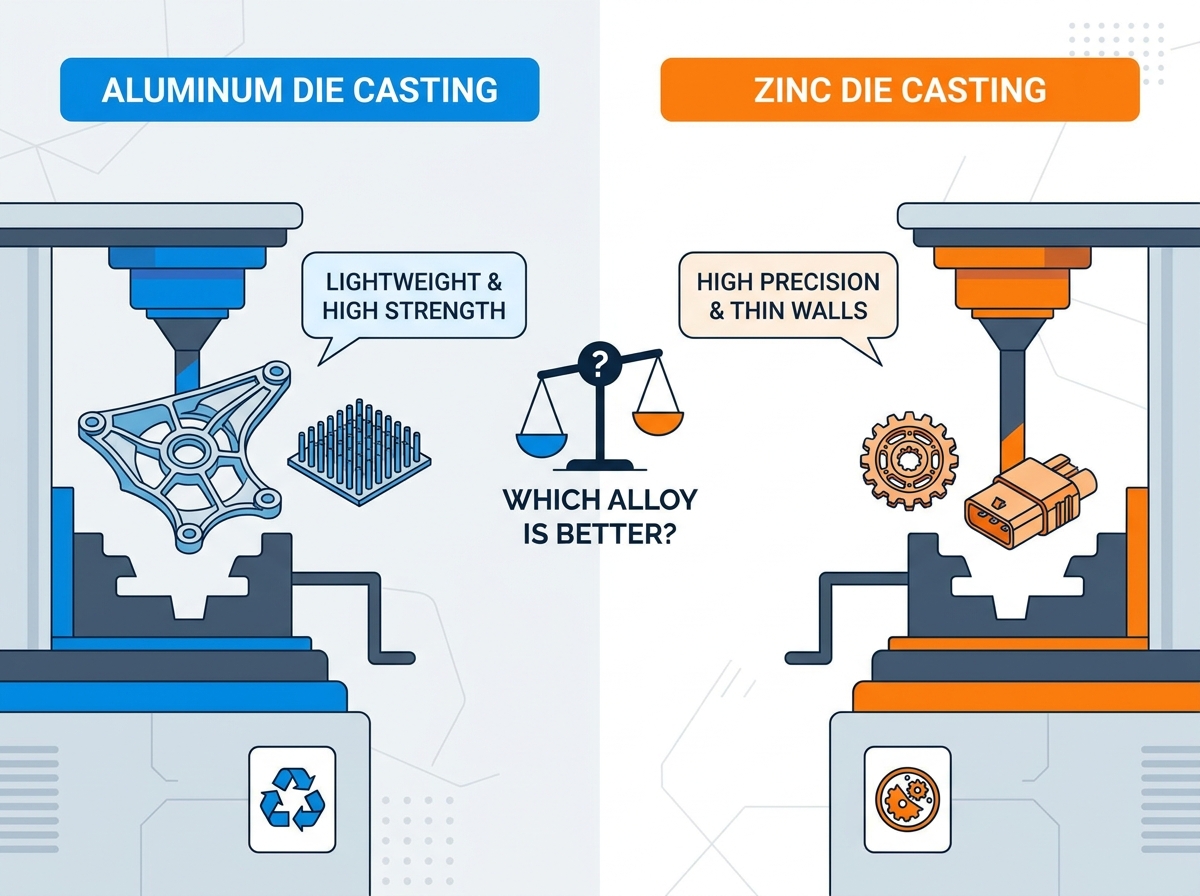
Specifying the wrong alloy in high-volume manufacturing introduces severe operational risks. Premature tool wear, catastrophic part failure in the field due to creep, excessive secondary CNC machining, and extended cycle times quickly destroy production schedules. Engineers face a complex challenge balancing mechanical performance requirements—such as tensile strength, weight limits, thermal dissipation, and corrosion resistance—with production economics like tooling amortization, cycle times, raw material volatility, and post-processing scrap rates. You need a rigorous technical evaluation framework to objectively compare aluminum and zinc alloys based on part geometry complexity, application environment, and mechanical loading. This guide breaks down the exact engineering metrics and shop-floor realities you must consider before cutting steel for your next mold.
Tooling Longevity: Zinc significantly outperforms aluminum in mold life (up to 1,000,000+ shots vs. 100,000–150,000 shots) due to lower processing temperatures, drastically reducing long-term capital amortization costs.
Weight and Thermal Dynamics: Aluminum is mandatory for weight-sensitive applications (aerospace, automotive) and operating temperatures exceeding 200°F (93°C), where zinc alloys risk significant creep and mechanical degradation.
Precision and Complexity: Zinc's fluid properties allow for ultra-thin walls (down to 0.015 inches), tighter as-cast tolerances, and zero-draft features, which often completely eliminate the need for secondary machining.
Process Machinery: The choice of alloy dictates the machinery used—hot-chamber for zinc vs. cold-chamber for aluminum—directly impacting cycle times, energy consumption, and capital expenditures during the die casting manufacturing process.
Key Engineering Metrics: Aluminum vs. Zinc Comparison Matrix
Understanding the fundamental physical and mechanical properties of these metals dictates the entire engineering approach. You cannot design a part without first knowing how the molten material behaves under pressure and how it solidifies within the die cavity. The tables below outline the baseline metrics for standard aluminum and zinc alloys used in everyday manufacturing.
Density plays a massive role in part weight and material consumption. Aluminum is exceptionally light, making it the default for automotive and aerospace components where mass reduction is non-negotiable. Zinc is heavy. It feels substantial in the hand, which is excellent for consumer goods requiring a premium feel, but it adds significant mass to moving assemblies. Thermal conductivity also differs. Aluminum dissipates heat rapidly, making it the standard for electronic housings and LED heat sinks. Zinc handles heat well but falls short of aluminum's thermal transfer rates.
Physical Properties Comparison
Property
Aluminum (A380)
Zinc (Zamak 3)
Density (g/cm³)
2.74
6.60
Melting Range (°F/°C)
1000-1100 / 540-595
715-728 / 380-387
Thermal Conductivity (W/m·K)
109
113
Coefficient of Thermal Expansion (µm/m·°C)
22.0
27.4
Mechanical properties dictate how the part survives in the field. Aluminum offers higher absolute tensile strength, but zinc provides superior impact resistance and ductility. When a zinc part takes a hit, it tends to deform rather than fracture. This ductility allows engineers to design parts with cast-in rivets or tabs that are bent over during assembly. Aluminum, being more brittle in its cast state, typically requires threaded fasteners or secondary joining methods.
Mechanical Properties Comparison
Property
Aluminum (A380)
Zinc (Zamak 3)
Tensile Strength (MPa)
324
283
Yield Strength (MPa)
159
221
Elongation in 2 inches (%)
3.5
10.0
Hardness (Brinell)
80
82
Impact Strength (Charpy V-Notch, ft-lbs)
3.0
43.0
Modulus of Elasticity (GPa)
71.0
85.5
Understanding the Die Casting Manufacturing Process for Aluminum and Zinc
At the most basic level, die casting forces molten non-ferrous metal into hardened H13 tool steel molds under extreme hydraulic pressure. We are talking about injection pressures ranging from 3,000 to over 15,000 psi. The metal enters the cavity in milliseconds, atomizes, and solidifies almost instantly against the water-cooled steel. However, the specific machinery required to handle zinc versus aluminum is completely different due to melting temperatures and metallurgical behavior.
The Hot-Chamber Process (Zinc-Focused)
Zinc runs on hot-chamber machines. In this setup, the injection mechanism—consisting of a plunger and a gooseneck—sits permanently submerged in a holding furnace filled with molten zinc. Because zinc melts at a relatively low temperature (around 720°F) and does not aggressively attack steel, the internal pumping components survive continuous exposure to the liquid metal.
When the machine cycles, the plunger retracts, allowing molten zinc to fill the gooseneck. The plunger then fires downward, forcing the metal through the nozzle and directly into the die cavity. This direct injection path eliminates the need to transport metal through the air. It keeps the metal at a perfectly consistent temperature right up to the gate. The thermodynamic efficiency here is massive. Hot-chamber machines cycle incredibly fast. For small zinc components, a well-tuned machine can hit 1,000 shots per hour. The limiting factor is usually how fast the die cooling lines can pull heat out of the tool so the part can be ejected without warping.
The Cold-Chamber Process (Aluminum-Focused)
Aluminum requires a cold-chamber process. You cannot leave a steel plunger submerged in molten aluminum. Aluminum melts at over 1,000°F and has a high chemical affinity for iron. If you put a steel gooseneck into an aluminum furnace, the aluminum will dissolve the steel, destroying the injection mechanism in hours and contaminating the alloy with iron.
Instead, the die casting manufacturing process for aluminum separates the melting furnace from the injection system. A robotic ladle scoops a precise volume of molten aluminum from the holding furnace and pours it into a horizontal steel tube called the shot sleeve. A hydraulic plunger then advances through the shot sleeve, pushing the metal into the die. Because the metal is poured through the ambient air into a relatively cool sleeve, it begins losing heat immediately. This requires massive hydraulic force to pack the metal into the cavity before it freezes. The ladling step, combined with the longer cooling times required for the hotter metal, makes cold-chamber cycles significantly slower than hot-chamber cycles.
Aluminum Die Casting: Capabilities, Strengths, and Limitations
Aluminum dominates the structural casting market. When you open the hood of a car or tear down a high-end power tool, you are looking at aluminum castings. It provides the necessary strength and thermal characteristics for heavy-duty applications, but it demands strict process control on the shop floor.
Mechanical and Thermal Properties
The primary advantage of aluminum is its strength-to-weight ratio. It delivers excellent structural rigidity at roughly one-third the weight of steel. This makes it the only logical choice for automotive transmission housings, engine blocks, and aerospace brackets. Aluminum also excels at thermal management. It pulls heat away from sensitive electronics rapidly. Furthermore, aluminum parts maintain their dimensional stability across wide temperature fluctuations. You can bolt an aluminum casting to a combustion engine, expose it to 400°F continuous heat, and it will not warp or lose its mechanical integrity. The material also forms a natural oxide layer upon exposure to air, providing a baseline level of corrosion resistance without any secondary coatings.
Common Aluminum Alloys Evaluated
Foundries rely on a few specific alloys to cover the vast majority of engineering requirements. Selecting the right one depends on the specific geometry of your part and the environment it will face.
A380 (ANSI/AA 380.0): This is the default alloy for most projects. It offers the best combination of material cost, castability, and mechanical strength. If you do not have a specific reason to use another alloy, you use A380.
A383 (ANSI/AA 383.0): When a part features complex, thin-walled geometries that A380 struggles to fill, foundries switch to A383. It flows better under pressure and resists hot-cracking as the part shrinks around the steel cores during solidification.
A360 (ANSI/AA 360.0): This alloy contains lower copper levels, which significantly boosts its corrosion resistance. It is heavily specified for marine applications and outdoor telecom enclosures. It is harder to cast than A380, requiring tighter temperature controls.
Implementation Risks, Failure Modes, and Mitigations
Casting aluminum is inherently violent. The high injection speeds cause the metal to atomize and trap air inside the cavity. This leads to gas porosity—microscopic voids inside the part that compromise structural integrity and cause blistering if the part is later powder coated and baked. Engineers mitigate this by designing massive overflows to catch the dirty, air-filled metal, or by implementing vacuum-assist systems that evacuate the air from the die milliseconds before the metal enters.
Tooling degradation is another major hurdle. Injecting 1200°F metal into a steel die causes rapid thermal expansion and contraction on the tool surface. Over time, this thermal fatigue causes the steel to crack, a condition known as heat checking. These cracks transfer onto the cast part as raised veins. To fight this, toolmakers use premium grades of H13 steel, apply specialized PVD coatings, and run complex internal cooling channels to manage the thermal shock. Soldering is also a constant threat. The aluminum wants to bond with the steel die. Foundries spray heavy water-based lubricants onto the die face between every shot to create a barrier, and engineers must design parts with generous draft angles (typically 1.5 to 2 degrees) so the part can eject without dragging against the steel.
Zinc Die Casting: Capabilities, Strengths, and Limitations
Zinc is the material of choice for precision, complexity, and aesthetics. It flows like water compared to aluminum, allowing toolmakers to design incredibly intricate molds that produce finished parts right out of the machine.
Mechanical and Physical Properties
Zinc absorbs energy exceptionally well. Its impact strength dwarfs that of cast aluminum. This toughness makes it ideal for mechanical components that take a beating, such as lock housings, gears, and seatbelt tensioners. The ductility of zinc is a massive advantage on the assembly line. You can cast a straight post on a zinc part, drop a mating component over it, and physically smash the post flat to rivet the assembly together. If you try that with standard cast aluminum, the post will snap off. Zinc also possesses natural lubricity. When zinc gears or bushings rub against other metals, they resist galling and wear, making the material perfect for internal mechanical linkages.
Common Zinc Alloys Evaluated
The zinc alloy family is highly standardized. The Zamak series covers almost all decorative and light structural needs, while the ZA series handles heavy-duty engineering applications.
Zamak 3 (ASTM AG40A): This alloy accounts for the vast majority of all zinc castings globally. It offers excellent dimensional stability and is the easiest alloy to electroplate or paint.
Zamak 5 (ASTM AC41A): By adding a small amount of copper to the mix, Zamak 5 increases tensile strength and hardness. It is used when Zamak 3 is just slightly too soft for the application, though it sacrifices a bit of ductility.
ZA-8 (ASTM zinc-aluminum): This is a high-performance structural alloy. It contains 8% aluminum, which significantly improves its creep resistance and tensile strength. It is the go-to choice when a zinc part must bear a continuous load.
Implementation Risks, Failure Modes, and Mitigations
The biggest engineering hurdle with zinc is its mass. At 6.6 g/cm³, it is heavy. If you take an aluminum part and cast it in zinc without changing the geometry, the part will weigh more than twice as much. Engineers mitigate this through aggressive thin-wall design. Because zinc flows so well, you can core out thick sections and reduce wall thicknesses down to 0.020 inches, removing unnecessary mass while maintaining structural ribs for rigidity.
The second major limitation is thermal creep. Zinc deforms under continuous mechanical stress at elevated temperatures. If you bolt a zinc bracket to a hot engine block and apply a load to it, the bracket will slowly stretch and loosen over time. Standard Zamak alloys have a strict continuous operating limit of 200°F (93°C). If the application environment exceeds this temperature, you must switch to aluminum or specify a high-performance ZA alloy and test it rigorously.
Head-to-Head Evaluation: Aluminum vs. Zinc Die Casting
Choosing between these metals requires looking past the raw material data sheets and understanding how they behave on the production floor. The differences in tooling life, machining requirements, and finishing capabilities often dictate the final engineering decision.
Tooling Life and Amortization Analysis
Die casting molds are massive capital investments, often costing tens or hundreds of thousands of dollars. The lifespan of that tool directly impacts the piece price. Zinc is incredibly gentle on H13 tool steel. Because it is injected at around 800°F, the thermal shock to the die is minimal. A well-maintained zinc die will easily run 1,000,000 shots before the cavity inserts need replacement. Aluminum, injected at 1200°F under higher pressures, destroys steel. An aluminum die will typically suffer severe heat checking and require major insert replacement between 100,000 and 150,000 shots. If you are running a program that requires 500,000 parts over five years, an aluminum design will force you to buy three or four replacement tools. A zinc design will run the entire program on the original tool.
Geometric Complexity, Tolerances, and Draft Angles
Zinc allows for near-net-shape manufacturing. It captures microscopic details from the mold, including cast-in part numbers, logos, and fine textures. Zinc holds linear tolerances of ±0.001 inches per inch right out of the machine. Aluminum typically holds ±0.002 inches per inch. Draft angles are another critical difference. Aluminum shrinks aggressively and solders to the die, requiring 1.0 to 2.0 degrees of draft on all vertical walls so the part can be pushed out of the mold. Zinc shrinks less and does not solder. You can often design zinc parts with 0.5 degrees of draft, and in some cases, zero draft on shallow internal cores. This lack of draft means zinc parts often fit together perfectly without needing a CNC mill to flatten the mating surfaces.
Surface Finishing, Coating, and Plating Performance
If your part requires a mirror-finish chrome plate, you use zinc. The surface of a zinc casting is dense and chemically receptive to multi-layer electroplating (copper-nickel-chrome). The plating adheres perfectly, providing a flawless cosmetic finish used on automotive interior trim and high-end plumbing fixtures. Aluminum is notoriously difficult to plate. The silicon in the aluminum alloys creates a barrier that resists plating adhesion. While aluminum can be powder coated or painted, it requires aggressive chemical conversion coatings (like chromate) to prepare the surface. Standard anodizing is also a failure on die-cast aluminum; the high silicon content turns the part a mottled, ugly dark grey or black rather than the bright colors seen on extruded aluminum.
Weight-to-Strength Trade-Offs (Specific Strength)
Specific strength is the ultimate deciding factor for structural components. It measures the material's strength divided by its density. Aluminum wins this category easily. When you need a part to hold a heavy load but add minimal weight to the overall assembly, aluminum is the only choice. Zinc is strong, but its high density ruins its specific strength ratio. You specify zinc when the raw impact resistance and ductility are more important than the weight penalty, or when the part is small enough that the added mass is negligible.
Decision Framework: Selecting the Right Alloy for Your Application
Do not rely on guesswork. Use a structured evaluation process to eliminate the wrong material early in the design phase. Review the operational environment, the mechanical loads, and the cosmetic requirements before locking in the CAD model.
When to Specify Aluminum
Aluminum is the correct choice when the physical environment demands thermal resilience and low mass. Review this checklist against your part requirements.
The maximum operating temperature of the part exceeds 200°F (93°C) under load.
Weight is a critical performance metric for the final assembly.
The design requires rapid thermal conductivity to cool internal electronic components.
The part will be exposed to the elements and requires natural atmospheric corrosion resistance without secondary paint.
The component is large and structural, requiring high absolute tensile strength.
When to Specify Zinc
Zinc is the correct choice when precision, tool life, and cosmetics outweigh the need for a lightweight component. Review this checklist to confirm zinc fits your program.
The expected production volume exceeds 300,000 units, making tool life a major financial factor.
The part requires ultra-thin walls, micro-features, or zero-draft internal cores that aluminum cannot fill.
A high-quality decorative finish, specifically electroplating, is mandatory for the consumer.
The assembly requires the part to be crimped, riveted, or bent during post-processing.
The component involves moving mechanical linkages that benefit from natural wear resistance.
Next Steps for Alloy Selection
Choosing between aluminum and zinc die casting requires balancing part weight, operating temperature, geometry, mechanical performance, finishing requirements, production volume, and total manufacturing cost.
Aluminum is generally the better choice for large structural components, heat-dissipation applications, outdoor environments, and assemblies where weight reduction is critical. Zinc is more suitable for smaller precision parts requiring thin walls, complex details, tight as-cast tolerances, high impact resistance, or decorative electroplating. Its lower processing temperature also supports faster cycles and significantly longer tooling life.
The final alloy decision should not be based on material price alone. Engineers should evaluate secondary machining, tool replacement, cycle time, coating requirements, and expected production volume. Mold-flow analysis and prototype validation can confirm whether the selected alloy will fill the geometry reliably and meet performance requirements before production tooling is finalized.
FAQ
Q: Can zinc die cast parts be used in high-temperature environments?
A: No. Standard zinc alloys suffer from severe creep and mechanical degradation at continuous operating temperatures above 200°F (93°C). If your component operates in a hot engine bay or near heating elements, aluminum is the required choice.
Q: Why do aluminum dies wear out faster than zinc dies?
A: Aluminum is injected at much higher temperatures (approximately 1200°F) than zinc (approximately 800°F). This extreme heat causes severe cyclic thermal shock on the H13 tool steel, leading to heat checking, cracking, and faster degradation of the mold cavity.
Q: Which alloy is better for electroplating?
A: Zinc is significantly better for electroplating. Its dense, chemically receptive surface allows for smooth, high-quality multi-layer plating (such as copper-nickel-chrome) with minimal surface preparation. Aluminum's high silicon content makes plating adhesion very difficult.
Q: Can I achieve thinner walls with aluminum or zinc?
A: Zinc allows for much thinner walls due to its superior fluidity under pressure. Zinc parts can be successfully cast with wall thicknesses down to 0.015 inches, whereas aluminum typically requires a minimum wall thickness of 0.040 inches to prevent cold shuts.
Q: Does aluminum require more secondary machining than zinc?
A: Yes. Zinc holds tighter as-cast tolerances, requires less draft angle, and casts complex near-net shapes easily. This precision often eliminates the need for the secondary CNC milling, facing, and deburring steps that are frequently required to finish aluminum parts.
With so many years' hard work and development, Ningbo Joyo Metal has built a competitive supply chain in the market to serve the distinguished customers all over the world.
About Us
Your partner for customized metal components/parts manufacturing

 English
 العربية
 Français
 Русский
 Español
 Português
 Deutsch
 italiano
 日本語
日本語 한국어
한국어 Nederlands
 Tiếng Việt
 ไทย
ไทย Polski
 Türkçe
 አማርኛ
አማርኛ ພາສາລາວ
 ភាសាខ្មែរ
 Bahasa Melayu
 ဗမာစာ
ဗမာစာ தமிழ்
தமிழ் Filipino
 Bahasa Indonesia
 magyar
 Română
 Čeština
 Монгол
 қазақ
қазақ Српски
 हिन्दी
 فارسی
فارسی Kiswahili
 Slovenčina
 Slovenščina
 Norsk
Norsk Svenska
 українська
 Ελληνικά
 Suomi
Suomi עברית
עברית Dansk
Dansk Afrikaans
 Gaeilge
 Eesti keel
 latviešu
 Беларуская мова
 Български
 Català
 Lietuvių
 Lëtzebuergesch
 Македонски