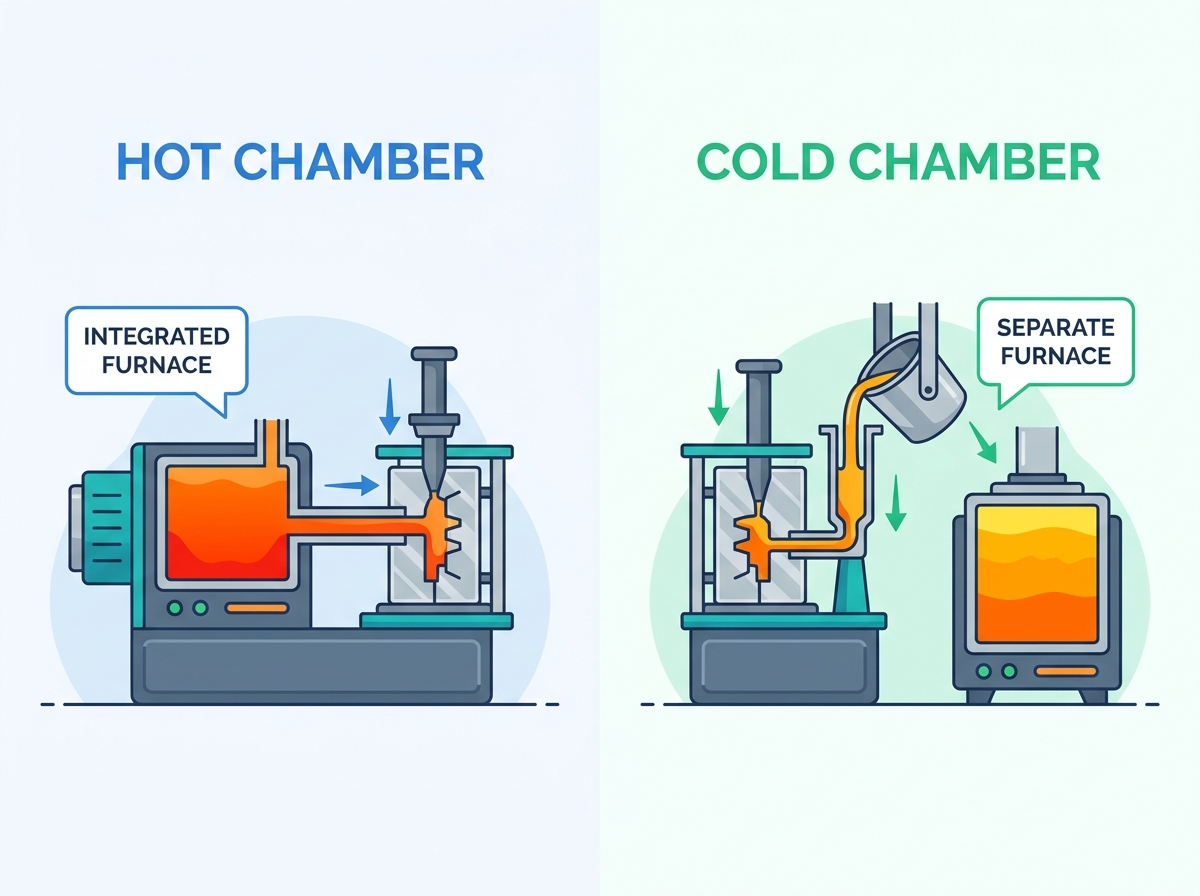
Choosing the wrong injection mechanism for metal part production leads to accelerated tool wear, unacceptable porosity levels, and inflated production scrap. Product designers and procurement engineers often struggle to balance material requirements with production efficiency. You need high strength-to-weight ratios from metals like aluminum. You also need fast cycle times, tooling longevity, and low scrap rates.
The decision between hot chamber and cold chamber systems is rarely a preference. Metallurgy, production volume, and thermal dynamics dictate the choice entirely. This guide evaluates both methods through an engineering lens. We will examine how each process impacts cycle efficiency, defect minimization, and structural integrity on the factory floor.
Material Dictates the Machine: Hot chamber machines are restricted to low-melting-point alloys (zinc, magnesium, lead) to prevent degradation of the internal injection mechanism. Cold chamber machines are mandatory for high-melting-point alloys (aluminum, brass, copper).
Cycle Time Discrepancies: Hot chamber processes generally offer faster cycle times (up to 15 cycles per minute / 900 shots per hour) due to the continuous immersion of the injection mechanism in the molten bath.
Tooling and Maintenance Costs: Cold chamber systems incur higher maintenance costs due to thermal shock on the ladle and plunger, while hot chamber systems require frequent maintenance of the gooseneck if used near their thermal limits.
Yield and Scrap Efficiency: Hot chamber casting produces less runner and sprue waste, whereas cold chamber casting inherently generates a solid "biscuit" of excess metal in the shot sleeve that must be recycled.
Quality and Porosity: Both methods require strict thermal management and venting to control porosity, but cold chamber transfer processes introduce higher risks of premature metal solidification and oxidation.
The Basic Principles of Die Casting
Understanding the basic principles of die casting requires looking at the core mechanism. The process involves injecting molten metal under high pressure into a reusable steel mold. This mold, called a die, shapes engineered parts with high dimensional accuracy and excellent surface finish. Operators lock the die halves together using massive hydraulic force before injection begins. The clamping force must exceed the separation force generated by the injected metal to prevent flash.
While clamping, venting, and ejection phases remain similar across all machines, the injection system differs fundamentally. The divergence lies in how the equipment holds, measures, and injects the molten metal into the die cavity. This specific mechanism defines the entire production line setup. The injection phase itself is split into multiple stages, typically a slow approach to push air out of the sleeve, followed by a rapid fill, and finally an intensification phase to squeeze the solidifying metal and reduce shrinkage porosity.
Evaluating casting success relies on three pillars. First, metallurgical compatibility ensures the metal does not destroy the machine components. Second, cycle efficiency determines production throughput and machine utilization. Third, defect minimization focuses on reducing gas porosity, shrinkage porosity, cold shuts, and blistering. Mastering these elements guarantees structural integrity in the final component. Proper die lubrication and thermal management through internal cooling lines are also mandatory to maintain consistent part dimensions over thousands of shots.
Hot Chamber Die Casting: Mechanics and Capabilities
The hot chamber process relies on an internal architecture called the gooseneck mechanism. The injection mechanism, including the gooseneck and plunger, remains permanently submerged in the holding furnace. Gravity fills the chamber via an inlet port when the plunger retracts. The hydraulic plunger then forces the molten metal through the gooseneck and nozzle directly into the die. This direct connection eliminates the need to transfer metal through the open air.
This process has a strict metallurgical sweet spot. Ideal materials include zinc (Zamak 3, Zamak 5, ZA-8), lead, and specific magnesium alloys like AZ91D. These alloys melt below 450°C (842°F). Keeping temperatures low prevents the molten metal from alloying with, eroding, or thermally fatiguing the submerged steel components. If you run temperatures too high, the molten metal will solder to the gooseneck and plunger rings, causing immediate mechanical binding.
Hot chamber systems offer distinct production advantages on the shop floor:
High-Speed Throughput: Rapid cycles occur due to the elimination of external manual or robotic ladling steps. The machine simply retracts the plunger and fires again.
Reduced Metal Oxidation: The system draws molten metal from deep below the bath surface, minimizing dross and oxide inclusion in the final part.
Tighter Temperature Control: Integrated holding pots allow direct, continuous thermal monitoring, keeping the metal at a highly stable casting temperature.
Material Yield: The nozzle design allows excess metal to flow back into the holding pot before solidification, minimizing sprue waste and reducing remelting energy.
Despite these benefits, inherent limitations exist. You absolutely cannot cast aluminum or copper alloys in a hot chamber machine. These highly reactive, high-melting-point metals rapidly dissolve submerged iron and steel components. Attempting this leads to catastrophic equipment failure within hours. The plunger will seize, and the gooseneck will erode from the inside out.
Cold Chamber Die Casting: Mechanics and Capabilities
Cold chamber die casting utilizes an external melting process. A separate holding furnace melts the metal. A robotic ladle or human operator transfers this molten metal into an unheated horizontal shot sleeve. Once the metal sits in the sleeve, a hydraulic plunger advances to force it into the die cavity. The sleeve is termed "cold" because it is not submerged in the molten bath, though it does absorb significant heat during operation.
This external transfer is mandatory for specific metals. Aluminum alloys like A380, A383, and ADC12 require this method. Brass and copper also demand cold chamber processing. These metals possess melting points ranging from 600°C to over 1000°C. At these temperatures, aluminum acts as a universal solvent, aggressively attacking and dissolving standard steel machine components if left in continuous contact.
Cold chamber production provides several unique advantages for heavy industry:
High-Strength, Lightweight Components: The process enables the production of structural parts crucial for automotive, aerospace, and telecommunications applications.
Alloy Flexibility: Swapping alloy compositions is easier since melting occurs in a modular, external furnace rather than a massive integrated machine pot. You can drain a holding furnace and switch from A380 to A356 relatively quickly.
Massive Part Scaling: Machines scale to high clamping forces, reaching up to 4,000+ tons. This produces large structural components like EV battery trays, engine blocks, and transmission housings.
The process also carries inherent limitations that require strict process control:
Slower Cycle Times: The physical metal transfer step and longer cooling phases add significant duration to each cycle. The ladle must move from the furnace to the pour hole, pour, and return.
Thermal Loss and Cold Shuts: Thermal drop during transfer requires higher initial furnace temperatures. It also increases the risk of premature solidification if shot speeds lack precise management.
The "Biscuit" Waste: The injection stroke inherently leaves a solid cylinder of excess metal in the shot sleeve. Operators must trim and recycle this biscuit, which adds handling time and energy costs for remelting.
Head-to-Head Technical Evaluation
Comparing these two processes requires looking at exact technical parameters. Each method serves distinct engineering requirements based on material properties and part geometry. You cannot force a part designed for a cold chamber into a hot chamber machine without changing the base material.
Feature / Parameter
Hot Chamber Die Casting
Cold Chamber Die Casting
Compatible Alloys
Zinc, Magnesium, Lead, Tin
Aluminum, Brass, Copper, High-Alloy Magnesium
Melting Point Limit
Typically < 450°C (842°F)
Typically > 600°C (1112°F)
Typical Cycle Times
Extremely fast (Up to 15 shots/min for small parts)
Moderate (1 to 3 shots/min depending on part size)
Injection Pressures
Lower (1,000 to 4,000 psi / 7 to 28 MPa)
Higher (3,000 to 15,000+ psi / 20 to 100+ MPa)
Clamping Force Capacity
Lower to Moderate (Typically up to 1,000 tons)
Extremely High (Up to 4,000+ tons for giga-castings)
Tooling Lifespan
Long (1M+ shots for zinc)
Moderate (100k to 200k shots for aluminum)
Wall Thickness Minimums
Ultra-thin (Down to 0.5 mm for zinc)
Thin (Typically 1.5 mm to 2.5 mm minimum)
Cycle times and production throughput differ drastically. Hot chambers provide continuous, rapid-fire capability. Cold chambers rely on a discrete, multi-step process. A small zinc part might cycle 15 times per minute. A similar-sized aluminum part in a cold chamber might only cycle twice per minute due to the ladling and extended cooling time required for the hotter metal.
Tooling and consumables experience different wear patterns. Hot chambers see wear on the gooseneck, plunger, and nozzle. Cold chambers experience severe thermal shock on the shot sleeve, plunger tip, and pouring ladle. Replacing these consumables over a 100,000-shot run requires careful maintenance planning. Plunger tips in cold chamber machines require constant lubrication and frequent replacement to maintain vacuum integrity and prevent metal flashing behind the tip.
Part quality relies heavily on minimizing defect rates. The cold chamber's pouring process exposes molten metal to air. This increases the risk of air entrapment and oxidation. Achieving structural integrity comparable to hot chamber outputs often necessitates advanced vacuum-assisted techniques. Hot chambers naturally protect the metal from air exposure by keeping the injection mechanism submerged, resulting in inherently lower gas porosity.
Energy consumption and thermal management also diverge. Hot chambers maintain a single integrated furnace efficiently. Cold chambers require managing a primary melting furnace alongside a secondary holding furnace at the machine. This dual-furnace setup demands higher overall energy input to maintain stable casting temperatures and compensate for heat lost during the ladling transfer.
Decision Framework: Choosing the Right Die Casting Process
Selecting the correct process requires a systematic approach. You must evaluate material needs, part geometry, and equipment capabilities before cutting any steel for the die.
Step 1: Material Selection as the Primary Filter
The decision almost always happens at the material selection phase. If the part requires the high thermal conductivity or low weight of aluminum, cold chamber is the only option. If the design requires tight tolerances, easy plating, and high impact strength from zinc, hot chamber becomes the default choice. Do not try to adapt the machine to the wrong metal.
Step 2: Wall Thickness and Dimensional Tolerances
Complex, thin-walled housing components demand specific flow characteristics. Evaluate whether zinc’s high fluidity in a hot chamber system is necessary to fill thin sections without misruns. Alternatively, determine if aluminum in a high-pressure cold chamber system can meet the structural criteria without compromising the thin walls. Zinc can generally cast thinner walls than aluminum due to its lower melting point and higher fluidity.
Step 3: Volume, Part Size, and Clamping Force Requirements
Evaluate part size and weight against physical machine limits. Determine if the component exceeds the physical shot-weight capacities of hot chamber machinery. Large structural parts inherently demand the massive clamping force and shot capacity found only in large-tonnage cold chamber equipment. Calculate the projected area of the part and runners to ensure the machine has adequate locking force to prevent flash.
Implementation Risks and Mitigation Strategies
Thermal fatigue and die checking present serious implementation risks. Extreme thermal cycling in cold chamber aluminum casting causes rapid die wear. The surface of the die expands rapidly when hit with molten aluminum and contracts just as fast when sprayed with die lubricant. Engineers mitigate this by designing conformal cooling channels. Utilizing premium H13 hot-work tool steels, properly heat-treated and stress-relieved, also extends die life under severe thermal stress.
Managing porosity remains critical for structural parts. Engineers must use flow simulation software like MAGMASOFT or Flow-3D during the Design for Manufacturability (DFM) phase. This software optimizes gating, venting, and overflow placement. Proper simulation prevents trapped gas regardless of the chamber type used. It allows you to visualize the metal front and adjust gate velocities before manufacturing the physical die.
Automated ladling and real-time process monitoring stabilize cold chamber setups. Automation minimizes human error during the metal transfer phase, ensuring a consistent pour volume and minimizing temperature drop. Real-time shot-curve monitoring tracks plunger position, velocity, and pressure, reducing cycle variability. These technologies work together to control cold-shut defects and maintain consistent metal temperatures.
Vendor selection audits ensure production reliability. Audit your manufacturing partner based on their specific machine tonnages and automation capabilities. Verify their metallurgical lab resources, checking for spectrometers and X-ray equipment. Review historical defect rates specifically for the chamber type your product requires. Ensure they have a robust preventative maintenance program for their shot sleeves and goosenecks.
Conclusion
Hot chamber and cold chamber systems are complementary processes dictated by metallurgy, thermal physics, and part geometry. Zinc and magnesium demand the speed of hot chambers. Aluminum and brass require the robust nature of cold chambers. To move forward with your production planning, take the following actions:
Finalize your material specifications based on mechanical requirements before selecting a machine type.
Run mold flow simulations to identify potential porosity and cold shut risks early in the design phase.
Audit potential manufacturing facilities to ensure they possess the exact tonnage and automation required for your chosen alloy.
Design parts with uniform wall thickness to optimize cooling rates and reduce thermal fatigue on the die.
FAQ
Q: Can magnesium be cast in both hot and cold chamber machines?
A: Yes. Smaller magnesium parts often use hot chamber machines for faster cycle times. Larger magnesium components, or those using specific high-alloy grades, require cold chamber machines to accommodate larger shot weights and clamping forces.
Q: Why does cold chamber casting produce a "biscuit"?
A: The cold chamber process pours molten metal into a horizontal shot sleeve. The plunger pushes the metal into the die, but cannot enter the die cavity itself. The excess metal remaining in the sleeve solidifies into a biscuit, which is ejected with the part.
Q: How does vacuum assist improve cold chamber casting?
A: Vacuum systems evacuate air from the die cavity and shot sleeve just before injection. This drastically reduces the amount of air trapped in the molten metal, lowering gas porosity and improving the mechanical strength of the final part.
Q: What causes die checking in cold chamber processes?
A: Die checking, or thermal fatigue cracking, occurs due to the extreme temperature fluctuations. The die surface rapidly heats during molten metal injection and rapidly cools during the spray and ejection phases. Over time, this expansion and contraction cracks the steel.
Q: Is hot chamber casting always faster than cold chamber?
A: Generally, yes. Hot chamber machines eliminate the external metal transfer step. The injection mechanism remains submerged and ready to fire, allowing for continuous, rapid cycles compared to the discrete ladling required in cold chamber setups.
With so many years' hard work and development, Ningbo Joyo Metal has built a competitive supply chain in the market to serve the distinguished customers all over the world.
About Us
Your partner for customized metal components/parts manufacturing

 English
 العربية
 Français
 Русский
 Español
 Português
 Deutsch
 italiano
 日本語
日本語 한국어
한국어 Nederlands
 Tiếng Việt
 ไทย
ไทย Polski
 Türkçe
 አማርኛ
አማርኛ ພາສາລາວ
 ភាសាខ្មែរ
 Bahasa Melayu
 ဗမာစာ
ဗမာစာ தமிழ்
தமிழ் Filipino
 Bahasa Indonesia
 magyar
 Română
 Čeština
 Монгол
 қазақ
қазақ Српски
 हिन्दी
 فارسی
فارسی Kiswahili
 Slovenčina
 Slovenščina
 Norsk
Norsk Svenska
 українська
 Ελληνικά
 Suomi
Suomi עברית
עברית Dansk
Dansk Afrikaans
 Gaeilge
 Eesti keel
 latviešu
 Беларуская мова
 Български
 Català
 Lietuvių
 Lëtzebuergesch
 Македонски