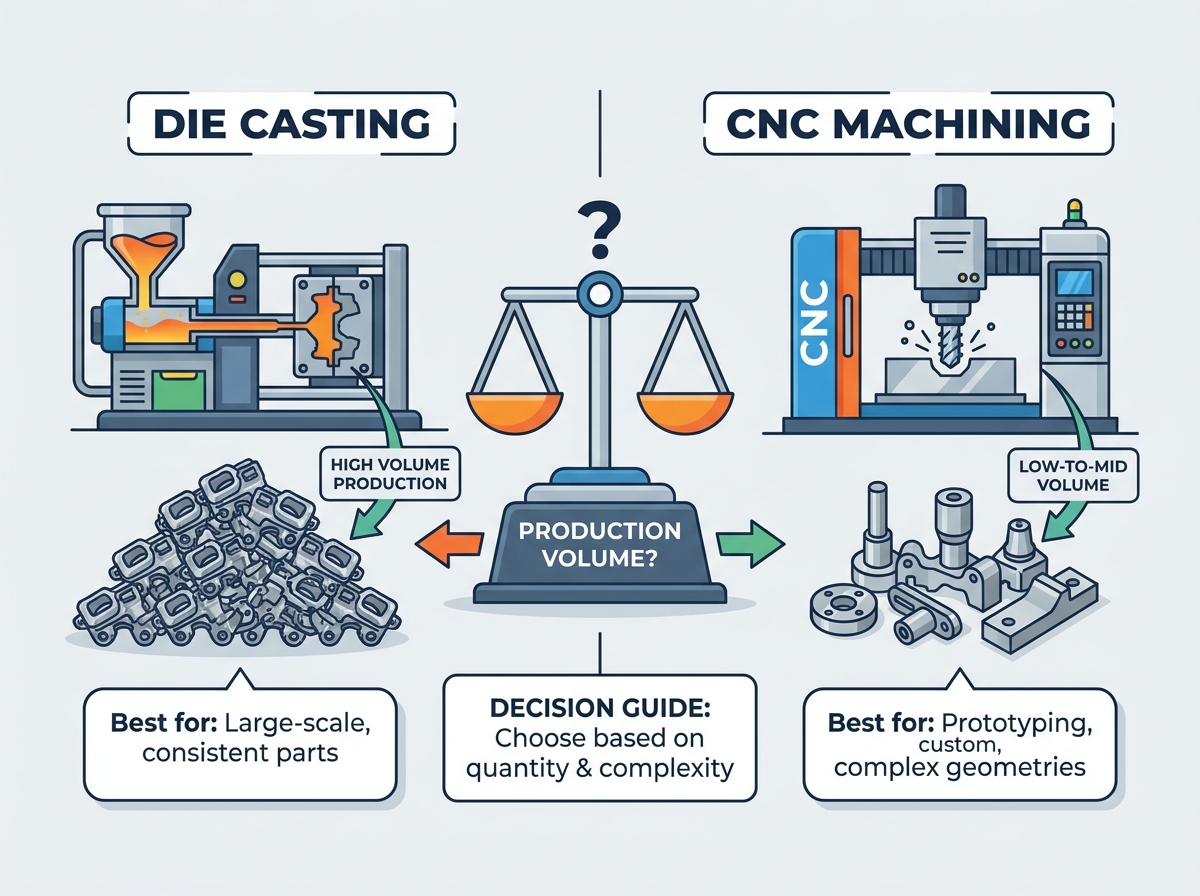
Bringing a hardware product to market forces engineering and procurement teams to confront a critical manufacturing crossroad. You must transition from prototyping to scalable production without destroying your unit economics. Selecting the wrong manufacturing process routinely leads to unrecoverable tooling investments, delayed time-to-market, or compromised mechanical integrity. A process that works perfectly for ten prototypes will likely bankrupt a project when scaled to ten thousand units if you fail to account for volume thresholds.
To navigate this transition successfully, hardware teams must rely on a rigorous, data-backed comparison of subtractive manufacturing versus net-shape forming. This article establishes a clear framework for evaluating CNC machining against die casting based on volume thresholds, geometric complexity, and overall unit economics. By understanding the mechanical realities and financial crossover points of each method, you can align your production strategy with your product lifecycle.
The Break-Even Reality: CNC machining dominates low-volume and high-precision requirements, while die casting becomes economically viable only after crossing specific volume thresholds that amortize high upfront tooling costs.
Material and Tolerance Trade-offs: CNC offers tighter baseline tolerances and broader material options; die casting provides rapid repeatability but introduces risks like porosity and requires specific alloy selections.
Lead Time Discrepancies: CNC machining allows for immediate production upon program completion, whereas die casting requires weeks to months for mold design, fabrication, and validation.
Design for Manufacturability (DFM): Transitioning between the two processes requires significant design modifications (e.g., adding draft angles for casting, removing undercuts for machining).
Process Fundamentals: Defining the Manufacturing Approaches
CNC machining is a highly precise subtractive process. It involves removing material from a solid billet using computer-controlled cutting tools. Modern machine shops utilize 3-axis, 4-axis, and 5-axis configurations to carve complex geometries out of raw metal blocks. The primary advantage of this method lies in its minimal tooling requirements. Aside from standard cutting tools, custom soft jaws, and basic workholding fixtures, no specialized molds are necessary.
Because there is no physical mold to fabricate, CNC machining offers immediate readiness for production. Once engineers finalize CAD/CAM programming, generate the toolpaths, and validate the G-code, the machine can start producing parts the very same day. This agility makes subtractive manufacturing the undisputed champion of rapid prototyping and early-stage production. Operators simply load the raw stock, set the work offsets, and initiate the cycle. The machine handles the rest, cutting away material until the final shape emerges.
Subtractive manufacturing also provides unparalleled flexibility. If a design change occurs, engineers simply update the CAD model, regenerate the toolpath, and send the new program to the machine. There are no physical molds to modify or scrap. This rapid iteration capability is essential during the early stages of product development when designs are still fluid and subject to frequent revisions based on testing feedback.
Die Casting: High-Volume Net-Shape Forming
In contrast to subtractive methods, net-shape forming creates parts by forcing molten metal under high pressure into reusable steel molds, known as dies. This process produces near-net-shape components at incredible speeds. For engineers looking to master this manufacturing vertical, understanding the thermal dynamics and metal solidification mechanics is essential. You can explore a complete guide to die casting to grasp the foundational mechanics before diving into comparative analysis.
The industry relies on two primary methodologies, dictated by material compatibility:
Hot-Chamber Die Casting: This method is best suited for low-melting-point alloys such as zinc, magnesium, and lead. It features significantly faster cycle times because the injection mechanism is submerged directly in the molten metal bath.
Cold-Chamber Die Casting: This approach is strictly required for higher-melting-point alloys like aluminum, brass, and copper. The molten metal is ladled into a cold chamber before injection, preventing the rapid corrosion and degradation of the injection plunger components.
Net-shape forming requires a deep understanding of fluid dynamics and thermodynamics. The molten metal must fill the mold cavity completely before it begins to solidify. Engineers must carefully design gating systems to control the flow of metal and venting systems to allow trapped air to escape. Failure to optimize these parameters results in defects such as cold shuts, misruns, and excessive porosity.
The Production Volume Threshold: When to Transition
Low-Volume Production (1–1,000 units)
CNC machining remains the default choice for low-volume manufacturing. At this stage, the zero mold amortization costs provide unmatched financial flexibility. Hardware teams require high flexibility for design iterations and rapid design modification loops during early product launches. The prohibitive nature of casting Capital Expenditure (CapEx) at this stage results in an unjustifiable amortized cost-per-part. Investing heavily in a mold for a small batch makes no mathematical sense.
During low-volume runs, the focus is on validating the product in the market and refining the design. Subtractive manufacturing allows teams to produce functional parts in the final production material without committing to hard tooling. This approach mitigates risk and preserves capital. If a product fails to gain traction, the financial exposure is limited to the cost of the machined parts, rather than a massive upfront tooling investment.
Mid-Volume Production (1,000–10,000 units)
The mid-volume tier represents the gray area of manufacturing where the decision matrix becomes highly complex. Part complexity, raw material costs, and machining cycle times dictate the exact crossover point. In this range, teams often introduce hybrid manufacturing workflows. They might cast a near-net shape to minimize raw material waste, and subsequently utilize CNC machining to hit critical tolerances on threads, bearing bores, and sealing surfaces.
Evaluating the transition in this tier requires a detailed analysis of cycle times. If a part takes several hours to machine, the operational expenses will quickly surpass the cost of a mold. Conversely, if the part is relatively simple and can be machined in minutes, subtractive manufacturing may remain the most economical choice well into the thousands of units. Engineers must weigh the labor and machine time against the tooling investment.
High-Volume Production (10,000+ units)
Massive economies of scale make casting the superior financial and operational choice for mass production. The rapid cycle times of net-shape forming—often taking just seconds to minutes per shot—vastly outpace the sequential tool paths of subtractive manufacturing. Furthermore, multi-cavity molds can produce two, four, or eight parts simultaneously, driving unit costs down to a fraction of their machined counterparts.
At high volumes, the initial tooling investment becomes a negligible fraction of the overall project cost. The focus shifts entirely to minimizing the cycle time and maximizing material efficiency. Net-shape forming excels in both areas. The ability to produce complex geometries in a single operation eliminates the need for multiple machining setups and reduces the reliance on skilled labor.
Calculating the Break-Even Point (Tooling Amortization)
Procurement managers and hardware engineers must utilize a concrete mathematical framework to justify tooling investments. The fundamental equation is: (Total CNC Unit Cost * Volume) = (Casting Tooling Cost) + (Casting Unit Cost * Volume).
Consider a hypothetical scenario comparing a machined part with a high unit cost versus a cast part with a low unit cost but a substantial mold investment. The volume crossover point occurs exactly where the total cost of machining equals the total cost of casting plus the mold. Beyond this specific unit count, the high upfront tooling cost is fully amortized, and the net-shape forming process becomes the cheaper option. You must run this calculation for every component to determine the optimal manufacturing strategy.
Technical Evaluation Dimensions: Features to Outcomes
Feature
CNC Machining
Die Casting
Baseline Tolerances
±0.001 inches (±0.025 mm)
±0.005 inches (±0.127 mm)
Surface Finish (As-Processed)
32 to 125 Ra µin
64 to 125 Ra µin
Wall Thickness
Thick walls preferred; thin walls warp
Thin walls excel (1.5mm aluminum)
Material Options
Virtually any solid metal billet
Non-ferrous alloys (Al, Zn, Mg)
Dimensional Accuracy and Tolerances
CNC machining routinely achieves baseline tolerances of ±0.001 inches (±0.025 mm) or tighter. The rigid setup and precise toolpaths allow for exceptional accuracy. Conversely, casting typically holds ±0.005 inches (±0.127 mm) for the first inch, with tolerances expanding as part size increases. Thermal shrinkage, mold wear, and uneven metal cooling rates impact casting repeatability, whereas subtractive methods only contend with machine tool wear and minor thermal expansion of the machine spindle.
When designing for subtractive manufacturing, engineers can specify tight tolerances on nearly every feature. The machine will faithfully execute the programmed toolpath. In net-shape forming, tight tolerances should only be specified where absolutely necessary. Over-tolerancing a cast part will drive up the mold cost and increase the scrap rate. Critical dimensions are often left slightly oversized and machined to final tolerance in a secondary operation.
Geometric Complexity, Wall Thickness, and Design Rules
Subtractive manufacturing faces physical limitations. Internal sharp corners are constrained by the tool radius. Deep cavities lead to tool deflection and reach constraints. Undercuts require complex 5-axis setups or multiple manual fixtures, driving up cycle times.
Net-shape forming excels at complex external geometries, extremely thin walls (down to 1.5mm for aluminum and 1.0mm for zinc), and integrated cooling fins. However, it requires strict adherence to specific design rules. Draft angles of 1° to 3° are mandatory to allow part ejection without dragging. Uniform wall thickness is necessary to prevent sink marks and internal voiding, while generous fillet radii must be applied to avoid stress concentrations.
Designing for net-shape forming requires a fundamental shift in mindset. You must visualize how the molten metal will flow through the cavity and how the solid part will be ejected. Features that are trivial to machine, such as deep, straight-walled pockets, become major obstacles in a mold. Engineers must core out thick sections to maintain uniform wall thickness and add ribs to maintain structural integrity.
Surface Finish and Post-Processing Requirements
The as-machined surface finish of CNC parts typically ranges from 32 to 125 Ra µin, with the ability to achieve mirror-like finishes directly off the machine. The as-cast finish generally lands between 64 to 125 Ra µin. Cast components almost always require secondary operations. Facilities must trim flash, apply shot blasting or vibratory deburring, and perform selective secondary machining for high-tolerance mating surfaces, O-ring grooves, and tapped holes.
Post-processing adds time and cost to the manufacturing cycle. While a machined part may be ready for assembly immediately after leaving the mill, a cast part often requires a multi-step finishing process. Engineers must account for these secondary operations when calculating the true unit cost and lead time of a cast component.
Material Selection and Mechanical Properties
Machine shops can cut virtually any engineering metal or alloy billet, including Aluminum 6061/7075, Stainless Steel 304/316, Titanium, Brass, Copper, and Mild Steel. Casting materials are restricted to non-ferrous alloys with lower melting points, primarily Aluminum A380/A383, Zinc/Zamak alloys, and Magnesium AZ91D.
Regarding mechanical integrity, machined billet metal offers an isotropic, defect-free grain structure with higher tensile strength. Cast parts carry an inherent risk of internal gas porosity, flow marks, and shrinkage defects, which can compromise structural integrity if not strictly controlled. For applications requiring maximum strength-to-weight ratios, such as aerospace components, subtractive manufacturing from high-strength billets remains the only viable option.
Tooling Durability and Lifespan Considerations
Mold Wear and Degradation in Die Casting
Casting molds have a finite lifespan due to severe thermal shock, physical erosion, and heat checking—the micro-cracking of the steel mold caused by cyclic heating and cooling. Standard mold lifespan benchmarks vary heavily by material. Aluminum casting dies typically last between 100,000 and 150,000 shots before requiring major refurbishment. Zinc casting dies can exceed 1,000,000 shots due to zinc's significantly lower melting temperature. For extremely high-volume production runs, teams must budget for the cost implications of rebuilds, repairs, and eventual mold replacement.
Maintaining a mold requires a dedicated tooling program. Foundries must regularly inspect the die for signs of wear, polish the cavity surfaces, and replace worn ejector pins. Failure to maintain the mold will result in degraded part quality, increased flash, and eventual catastrophic failure of the tool. Engineers must factor tooling maintenance into their long-term production planning.
Tooling wear in CNC Machining
CNC tool wear involves the degradation of cutting inserts, end mills, and drills. Unlike massive steel molds, CNC tooling wear is managed dynamically. Modern machines utilize in-process tool setters, tool life management software, and rapid insert changes. Operators can swap a worn cutting edge in minutes at a very low cost, without stopping production for extended periods or requiring heavy machinery to pull a mold.
Tool life in subtractive manufacturing is highly predictable. Machinists can calculate the exact number of parts a specific end mill can produce before it needs replacement. This predictability allows for accurate cost modeling and prevents unexpected downtime. Advanced CAM software can even adjust feed rates and spindle speeds dynamically to optimize tool life and maintain consistent part quality.
Overall Value Influencing Factors (Unit Economics)
Upfront Capital Expenditure (CapEx) vs. Operating Expenses (OpEx)
Net-shape forming requires a massive upfront investment for hardened H13 tool steel dies, mold design engineering, and custom trim dies. Subtractive manufacturing avoids this CapEx but incurs significantly higher Operating Expenses (OpEx). CNC operations demand machine run-time charges, expert operator labor, complex tool path programming, expensive raw material billet costs, and substantial metal chip scrap rates.
The decision between CapEx and OpEx often depends on the company's financial structure and cash flow. Startups with limited capital may prefer the higher OpEx of subtractive manufacturing to avoid tying up funds in hard tooling. Established companies with predictable demand and strong balance sheets can leverage the high CapEx of net-shape forming to drive down long-term OpEx and maximize profit margins.
Cycle Times and Throughput Rates
CNC machining scales linearly with time; every added feature, hole, or pocket directly increases the cycle time. Casting operates on a fixed cycle time. Highly complex geometries, internal ribs, and mounting bosses are formed simultaneously in a single shot. When supply chain demands spike suddenly, the throughput capabilities of multi-cavity casting molds easily outperform rows of milling machines.
Throughput is a critical factor in scaling production. A single casting machine can produce thousands of parts per day, whereas a milling machine might only produce a few dozen. To match the output of a foundry, a machine shop would need to invest in dozens of machines, hire multiple operators, and secure a massive facility. Net-shape forming offers unparalleled scalability for high-volume products.
Material Waste, Buy-to-Fly Ratios, and Sustainability
Subtractive manufacturing suffers from high scrap rates. Often, 50% to 80% of the raw block is machined into chips. This material inefficiency severely impacts financial viability when using expensive alloys like titanium. Casting is highly material-efficient. It is a near-net-shape process where foundries can immediately remelt and recycle runners, sprues, gates, and flash directly on the floor, vastly improving sustainability metrics.
The buy-to-fly ratio—the weight of the raw material purchased compared to the weight of the final part—is a key metric in aerospace and high-performance manufacturing. Subtractive manufacturing often has a poor buy-to-fly ratio, driving up material costs and environmental impact. Net-shape forming minimizes waste and maximizes material utilization, making it a more sustainable and cost-effective choice for mass production.
Industry-Specific Preferences: Where CNC and Die Casting Dominate
Aerospace and Defense
The aerospace sector heavily prefers CNC machining. Flight-critical components demand strict structural integrity and have zero tolerance for internal porosity, which causes catastrophic fatigue failure. Furthermore, aerospace production volumes are typically low-to-medium, and designs frequently rely on specialized, high-strength alloys like Titanium or 7075 Aluminum that cannot be cast.
Aerospace manufacturers prioritize performance and reliability above all else. The isotropic grain structure of machined billets ensures consistent mechanical properties in all directions. Every component undergoes rigorous non-destructive testing to verify its integrity. The inherent risks of porosity and shrinkage defects in net-shape forming make it unsuitable for primary structural components in aircraft and spacecraft.
Automotive and Consumer Electronics
Automotive and consumer electronics industries are driven by extreme cost sensitivity and massive production volumes. They rely almost exclusively on casting for metal components. Geometries requiring thin walls for weight reduction—such as engine blocks, transmission cases, laptop chassis, and smartphone frames—are produced by the hundreds of thousands, making tooling amortization a non-issue.
In these industries, shaving a few cents off the unit cost can translate to millions of dollars in savings over the product lifecycle. Net-shape forming provides the necessary scale and efficiency to meet these aggressive cost targets. The ability to integrate multiple features into a single cast component also reduces assembly time and simplifies the supply chain.
Medical Devices
The medical device industry splits its applications based on the component's function. High-precision, low-volume surgical instruments and bone implants are CNC machined from biocompatible titanium or stainless steel. Conversely, mass-produced structural equipment covers, hospital bed frames, and monitor mounts utilize casting to keep production costs manageable.
Implants and surgical tools require exceptional surface finishes and strict adherence to biocompatibility standards. Subtractive manufacturing allows for the precise control necessary to meet these requirements. For non-critical structural components, net-shape forming offers a cost-effective way to produce durable, aesthetically pleasing parts in high volumes.
Implementation Risks and Mitigation Strategies
Design for Manufacturability (DFM) Constraints
Porting a CNC-optimized CAD file directly to a foundry will result in manufacturing failure, catastrophic tool damage, or unfillable features. To mitigate this risk, engineering teams must mandate an early DFM review phase. This review ensures the incorporation of proper draft angles, the coring out of thick solid sections to prevent sink marks, the insertion of rib reinforcements, and the design of proper gating and venting systems.
A successful DFM review requires close collaboration between the design engineers and the foundry tooling experts. The foundry will use mold flow simulation software to analyze the filling and solidification process, identifying potential defect areas before cutting any steel. Iterating on the design during this virtual phase saves countless hours and thousands of dollars in physical mold modifications.
Supply Chain and Lead Time Vulnerabilities
Tooling fabrication introduces a critical-path delay of 4 to 12 weeks for design, machining, heat treating, and first article inspection (FAI). Hardware teams must mitigate this lead time vulnerability by utilizing CNC machining for bridge production. Machining initial batches allows companies to launch products and generate revenue while waiting for the mass-production steel molds to be completed and validated.
Bridge production requires careful planning. The machined parts must function identically to the final cast parts, even though they are produced using a different method. Engineers must ensure that the design accommodates both processes, or maintain two separate CAD models during the transition phase. This strategy minimizes time-to-market while securing the long-term cost benefits of net-shape forming.
Conclusion
Choosing between CNC machining and die casting depends on production volume, material requirements, geometry, tolerance, lead time, and total lifecycle cost.
CNC machining is generally better for prototypes, low-volume production, frequent design changes, tight tolerances, and components requiring high-strength billet materials. Die casting becomes more economical at higher volumes, where rapid cycle times, near-net-shape production, and lower unit costs can justify the initial tooling investment.
The transition point should be calculated using actual tooling, machining, material, finishing, maintenance, and quality-control costs rather than a fixed production quantity. Many projects also benefit from a hybrid strategy: CNC machining supports prototyping and bridge production, while casting handles long-term volume, followed by selective machining of critical features.
Early DFM review and cost modeling are essential before committing to either process.
FAQ
Q: Can I use the same CAD file for both CNC machining and casting?
A: No. Cast parts require specific design modifications, including draft angles for ejection, uniform wall thicknesses to prevent warping, and cored-out sections. A machined part design will fail if cast without these DFM adjustments.
Q: Why is CNC machining preferred for aerospace components?
A: Aerospace components require absolute structural integrity and utilize high-strength alloys like titanium. Machining from solid billet eliminates the risk of internal gas porosity, preventing catastrophic fatigue failures under stress.
Q: How long does it take to get a casting mold made?
A: Fabricating a production-grade steel mold typically takes between 4 to 12 weeks. This lead time includes mold design, CNC machining of the tool steel, heat treatment, and First Article Inspection (FAI).
Q: What is the cheapest metal to cast?
A: Zinc is generally the most cost-effective metal to cast. It has a low melting point, which allows for extremely fast cycle times and extends the lifespan of the steel mold to over a million shots.
Q: Can cast parts be CNC machined afterward?
A: Yes. This is a common hybrid manufacturing approach. Parts are cast to a near-net shape to save material, and critical features like bearing bores, sealing surfaces, and threaded holes are subsequently CNC machined to tight tolerances.
With so many years' hard work and development, Ningbo Joyo Metal has built a competitive supply chain in the market to serve the distinguished customers all over the world.
About Us
Your partner for customized metal components/parts manufacturing

 English
 العربية
 Français
 Русский
 Español
 Português
 Deutsch
 italiano
 日本語
日本語 한국어
한국어 Nederlands
 Tiếng Việt
 ไทย
ไทย Polski
 Türkçe
 አማርኛ
አማርኛ ພາສາລາວ
 ភាសាខ្មែរ
 Bahasa Melayu
 ဗမာစာ
ဗမာစာ தமிழ்
தமிழ் Filipino
 Bahasa Indonesia
 magyar
 Română
 Čeština
 Монгол
 қазақ
қазақ Српски
 हिन्दी
 فارسی
فارسی Kiswahili
 Slovenčina
 Slovenščina
 Norsk
Norsk Svenska
 українська
 Ελληνικά
 Suomi
Suomi עברית
עברית Dansk
Dansk Afrikaans
 Gaeilge
 Eesti keel
 latviešu
 Беларуская мова
 Български
 Català
 Lietuvių
 Lëtzebuergesch
 Македонски